Equilibrium and Elasticity
Learning Objectives
- Define and apply the conditions for static equilibrium.
- Calculate the center of mass and understand its relation to the center of gravity.
- Define stress, strain, and understand their relationship through Hooke's Law.
- Analyze material deformation including tension, compression, shear, and bulk stress.
- Interpret proportional, elastic, yield, plastic, ultimate, and fracture landmarks without conflating them.
- Calculate free thermal strain and fully restrained thermal stress for the stated linear-elastic model.
For a structure like a bridge or a building to serve its purpose, it must remain stationary and maintain its shape under various loads. This requires the principles of static equilibrium and an understanding of how materials deform (elasticity).
Static Equilibrium
Static Equilibrium Concepts
An object is in static equilibrium if it is completely at rest in our chosen frame of reference. This means it has no linear acceleration and no angular acceleration.
For a rigid body (an object whose size and shape do not change under load), two conditions must be met simultaneously for it to be in equilibrium.
Translational Equilibrium Condition
The vector sum of all external forces must be zero.
Variables
| Symbol | Description | Unit |
|---|---|---|
| Net external force | N |
Translational Equilibrium in 2D
In 2D (xy-plane), the translational equilibrium condition breaks down into two scalar equations: and .
Rotational Equilibrium Condition
The vector sum of all external torques about any axis must be zero.
Variables
| Symbol | Description | Unit |
|---|---|---|
| Net external torque |
Choosing an Axis of Rotation
When applying the torque equation (), you are free to choose the axis of rotation anywhere you like. A strategic choice of axis (e.g., placing it exactly where an unknown force acts) will eliminate that unknown force from your torque equation, simplifying the math significantly.
Interactive Simulation
Use this torque balance model to see how lever arms and loads must offset each other for rotational equilibrium.
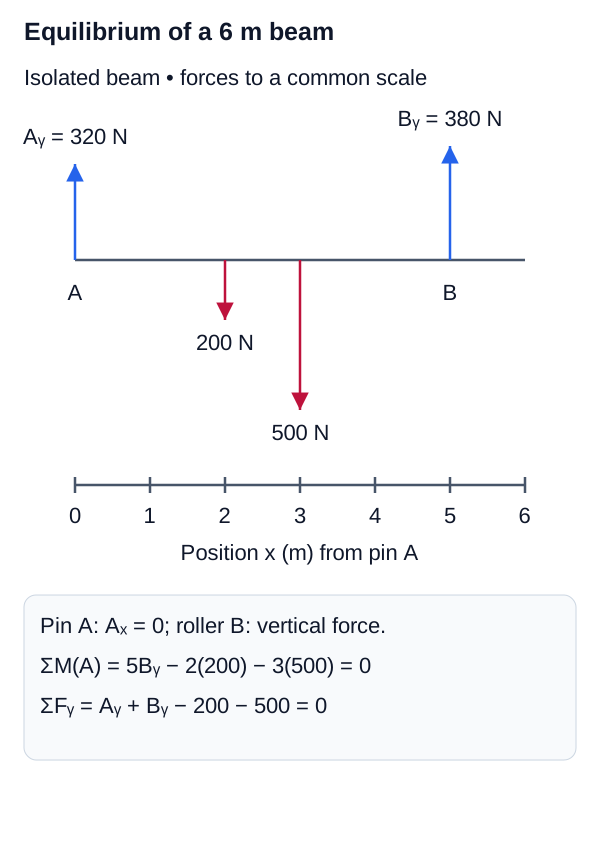
Rotational equilibrium: . The uniform beam weight passes through the pivot, so it contributes no moment about , but it is still included in the vertical reaction.
Static Equilibrium Requires a Complete FBD
Force equilibrium and moment equilibrium must be applied to the same isolated body with all external forces and lever arms shown.
Center of Gravity (CG)
Center of Gravity (CG) Concepts
The center of gravity is the point at which the entire weight of an object can be considered to act for the purpose of calculating torques due to gravity.
For a uniform object in a uniform gravitational field (like near the Earth's surface), the center of gravity coincides perfectly with the geometric center of mass (CM).
Center of Mass Location ()
The geometric center of a mass distribution.
Center of Mass for Discrete Masses
Calculates center of mass position for a system of discrete particles.
Variables
| Symbol | Description | Unit |
|---|---|---|
| Center of mass position | m | |
| Mass of particle i | kg | |
| Position of particle i | m |
Center of Mass for a Continuous Body
Calculates center of mass position for a continuous uniform body.
Variables
| Symbol | Description | Unit |
|---|---|---|
| Center of mass position | m | |
| Total mass | kg | |
| Length of the body | m | |
| Position along the length | m | |
| Infinitesimal mass element | kg |
Elasticity and Deformation
Elasticity and Deformation Concepts
In reality, no object is perfectly "rigid." When forces are applied, all materials deform to some extent. Understanding this deformation is the bridge between basic physics and "Mechanics of Materials," a core engineering subject.
Stress ()
Stress characterizes the intensity of the internal forces acting within a deformable body. It is the applied force per unit cross-sectional area. The SI unit is the Pascal (Pa), where .
Stress Equation
Calculates stress from applied force and cross-sectional area.
Variables
| Symbol | Description | Unit |
|---|---|---|
| Stress | Pa | |
| Perpendicular force applied | N | |
| Cross-sectional area |
Strain ()
Strain is the measure of the relative deformation (change in shape or size) of an object in response to stress. It is a dimensionless ratio.
Strain Equation
Calculates strain from change in length relative to original length.
Variables
| Symbol | Description | Unit |
|---|---|---|
| Strain | dimensionless | |
| Change in length | m | |
| Original length | m |
Hooke's Law for Continua
Hooke's Law for Continua Concepts
For small deformations, most solid materials exhibit elastic behavior: they return to their original shape when the stress is removed, and the strain is directly proportional to the stress. This is Hooke's Law applied to continuous media.
Hooke's Law
General relationship between stress and strain within the elastic limit.
Variables
| Symbol | Description | Unit |
|---|---|---|
| Applied stress | Pa | |
| Material property indicating stiffness | Pa | |
| Resulting strain | dimensionless |
Interactive Simulation
Adjust force, area, and elastic modulus to connect stress, strain, and stiffness before moving into mechanics of materials.
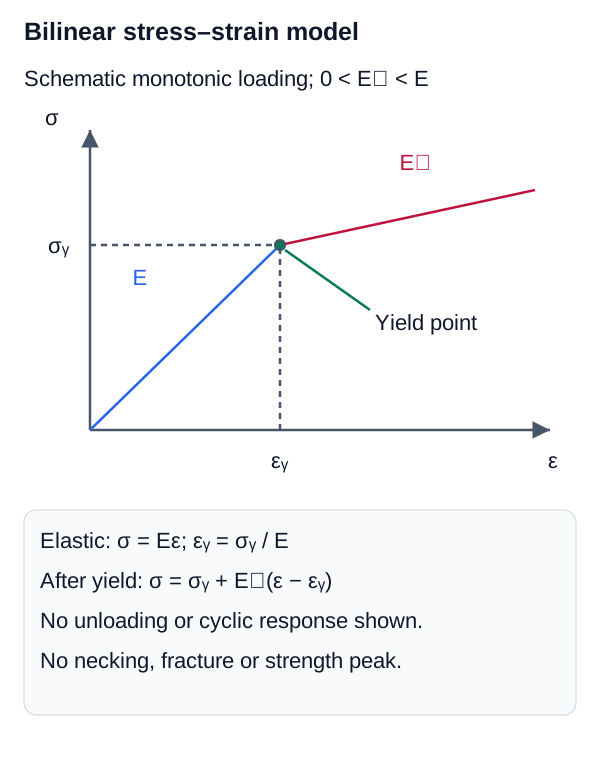
Constitutive definition
For σ ≤ σᵧ: ε = σ/E.
For σ > σᵧ: ε = εᵧ + (σ − σᵧ)/Eₜ.
In this deliberately simplified monotonic-loading law, the proportional limit and modeled yield point coincide. Real materials may not show that coincidence. Unloading and all ultimate/fracture behavior require a different constitutive model or material-specific data.
Explicit Bilinear Constitutive Model
The teaching model is linear elastic to its modeled yield point and then follows a lower tangent modulus. It does not represent ultimate strength, necking, or fracture.
Scope of the Interactive Constitutive Model
The interactive stress-strain curve is an explicitly idealized bilinear strain-hardening law. It is not a sourced material curve for steel, aluminum, titanium, copper, or any other specific alloy. In this idealization the proportional limit and modeled yield point coincide; real material data can distinguish these quantities and may exhibit nonlinear transition behavior.
Types of Elastic Moduli
The specific "Elastic Modulus" depends on the type of stress being applied. Common types include Young's Modulus, Shear Modulus, and Bulk Modulus.
Young's Modulus ()
Measures resistance to tension (stretching) or compression (squeezing) along one axis. This is crucial for designing columns and cables.
Young's Modulus Stress-Strain Equation
The fundamental relationship between stress and strain for tension or compression.
Variables
| Symbol | Description | Unit |
|---|---|---|
| Stress | Pa | |
| Young's Modulus | Pa | |
| Strain | dimensionless |
Young's Modulus Force-Area Equation
Relates applied force, area, and length changes for tension or compression.
Variables
| Symbol | Description | Unit |
|---|---|---|
| Force applied | N | |
| Cross-sectional area | ||
| Young's Modulus | Pa | |
| Change in length | m | |
| Original length | m |
Shear Modulus ()
Measures resistance to shear forces (forces acting parallel to a surface, trying to slide layers past one another), where is the shear strain angle.
Shear Modulus Equation
Hooke's Law applied to shear deformation.
Variables
| Symbol | Description | Unit |
|---|---|---|
| Shear stress | Pa | |
| Shear Modulus | Pa | |
| Shear strain | rad |
Bulk Modulus ()
Measures resistance to uniform compression from all sides (like an object submerged deep in the ocean). It relates pressure () to volume strain (). The negative sign in the equation indicates that increased pressure causes a decrease in volume.
Bulk Modulus Equation
Relates pressure change to volume strain.
Variables
| Symbol | Description | Unit |
|---|---|---|
| Change in pressure | Pa | |
| Bulk Modulus | Pa | |
| Change in volume | ||
| Original volume |
Thermal Stress
Thermal Stress Concepts
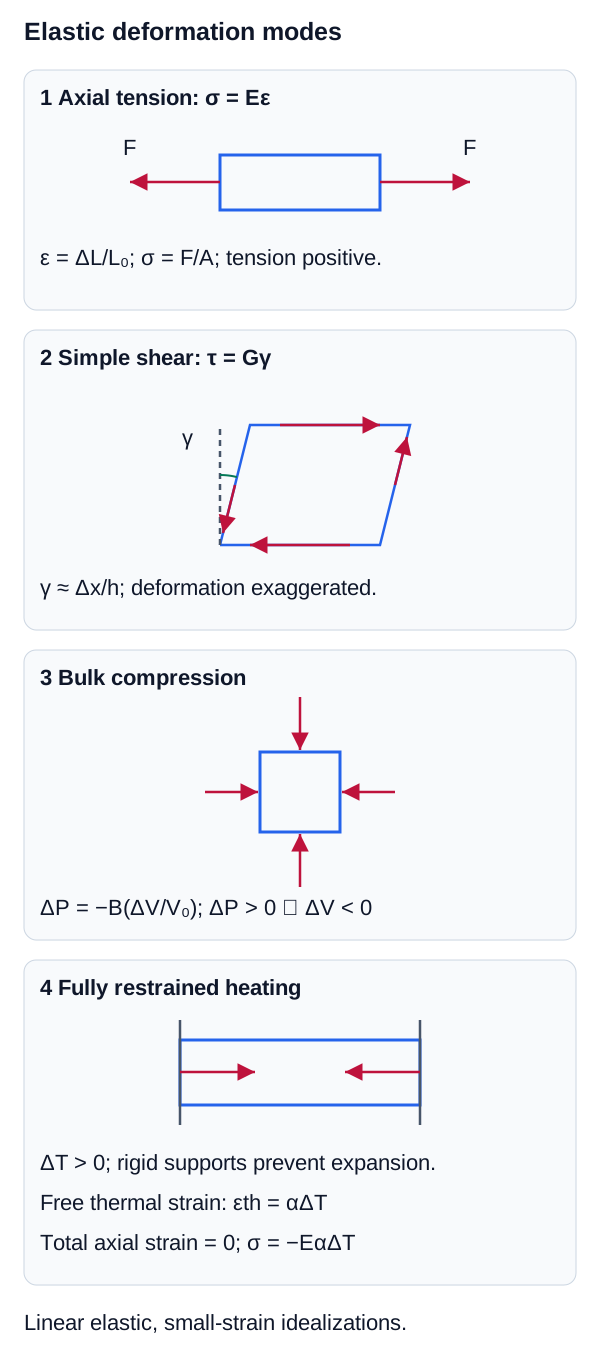
If a structural member is constrained so that it cannot expand or contract when subjected to a temperature change (), large internal stresses develop. The thermal strain is . Because the member is constrained, the opposing stress developed is defined by the thermal stress equation.
Thermal Stress Equation
Calculates stress caused by constrained thermal expansion or contraction.
Variables
| Symbol | Description | Unit |
|---|---|---|
| Thermal stress | Pa | |
| Young's Modulus | Pa | |
| Coefficient of linear expansion | ||
| Change in temperature |
Elastic Deformation Modes
Young's, shear, and bulk moduli relate different conjugate stress-strain measures; thermal strain becomes stress only when expansion or contraction is restrained.
The Stress-Strain Curve
The Stress-Strain Curve Concepts
If you steadily increase the tensile stress on a material (like a steel rod) and plot the resulting strain, you get a characteristic curve.
Landmarks on a Real Tensile Stress-Strain Curve
- Proportional limit: highest stress over which stress and strain remain proportional within the measurement/model definition.
- Elastic limit: highest stress from which the material can unload without permanent strain; it is conceptually distinct from the proportional limit.
- Yield: onset of appreciable plastic deformation, defined by a material-specific convention when a sharp yield point is absent.
- Plastic region: deformation includes a permanent component after unloading.
- Ultimate tensile strength: maximum engineering stress reached in a tensile test before the engineering-stress curve decreases during necking.
- Fracture: specimen separation. It must not be inferred from a model that does not include a fracture criterion.
Yield Strength Importance
Engineering designs almost always require materials to stay well below their Yield Strength, ensuring they remain in the elastic region under typical operating loads.
Shear and Bulk Moduli
Deformation Beyond Tension
While Young's Modulus () handles simple stretching and compression, complex structures experience other types of stress.
- Shear Stress and Strain: Forces acting parallel to a surface cause layers of the material to slide past one another. The Shear Modulus () relates shear stress () to shear strain (). This is critical in analyzing bolts, rivets, and torsion in drive shafts.
- Bulk Stress and Strain: Forces acting uniformly from all directions (like hydrostatic pressure underwater) cause volume changes. The Bulk Modulus () relates the change in pressure () to the fractional change in volume ().
Shear Modulus Equation
Hooke's Law applied to shear deformation.
Variables
| Symbol | Description | Unit |
|---|---|---|
| Shear stress | Pa | |
| Shear Modulus | Pa | |
| Shear strain | rad |
- Static Equilibrium requires both zero net force () and zero net torque ().
- The Center of Gravity is the point where the total weight acts. It coincides with the center of mass for uniform fields.
- Stress () measures the intensity of internal forces. Strain () measures the resulting deformation.
- Hooke's Law states that stress is proportional to strain in the elastic region, governed by an elastic modulus like Young's Modulus ().
- The proportional limit, elastic limit, yield behavior, ultimate strength, and fracture are distinct material-response concepts; the interactive bilinear model represents only the elastic and post-yield branches stated in its constitutive definition.