Thermodynamics
Learning Objectives
- Differentiate between temperature, heat, and internal energy.
- Calculate thermal expansion and heat required for temperature changes and phase changes.
- Explain the three mechanisms of heat transfer: conduction, convection, and radiation.
- Understand and apply the laws of thermodynamics (Zeroth, First, Second, and Third).
- Analyze thermodynamic processes and calculate the efficiency of heat engines.
- Relate macroscopic gas properties to microscopic behavior using the Ideal Gas Law and Kinetic Theory.
Temperature and Heat
Temperature and Heat Concepts
In everyday language, "heat" and "temperature" are often used interchangeably. In physics, they have very precise and distinct meanings.
Temperature ()
A thermodynamic state variable that determines the direction of spontaneous heat transfer when systems are placed in thermal contact. In the ideal-gas kinetic model, temperature is directly related to average molecular kinetic energy; that microscopic interpretation should not be generalized to every material without qualification. The SI unit is the kelvin (K), while Celsius (C) is also widely used in engineering.
Kelvin–Celsius Conversion
Converts Celsius temperature to absolute temperature in kelvins.
Variables
| Symbol | Description | Unit |
|---|---|---|
| Absolute temperature | K | |
| Celsius temperature | °C |
Heat ()
The transfer of energy between a system and its environment due solely to a temperature difference. Heat always flows spontaneously from an object at higher temperature to one at lower temperature. The SI unit is the Joule (J).
Heat vs. Internal Energy
A system has state properties such as temperature and internal energy. Heat is not a stored property; it is energy transferred across a system boundary because of a temperature difference.
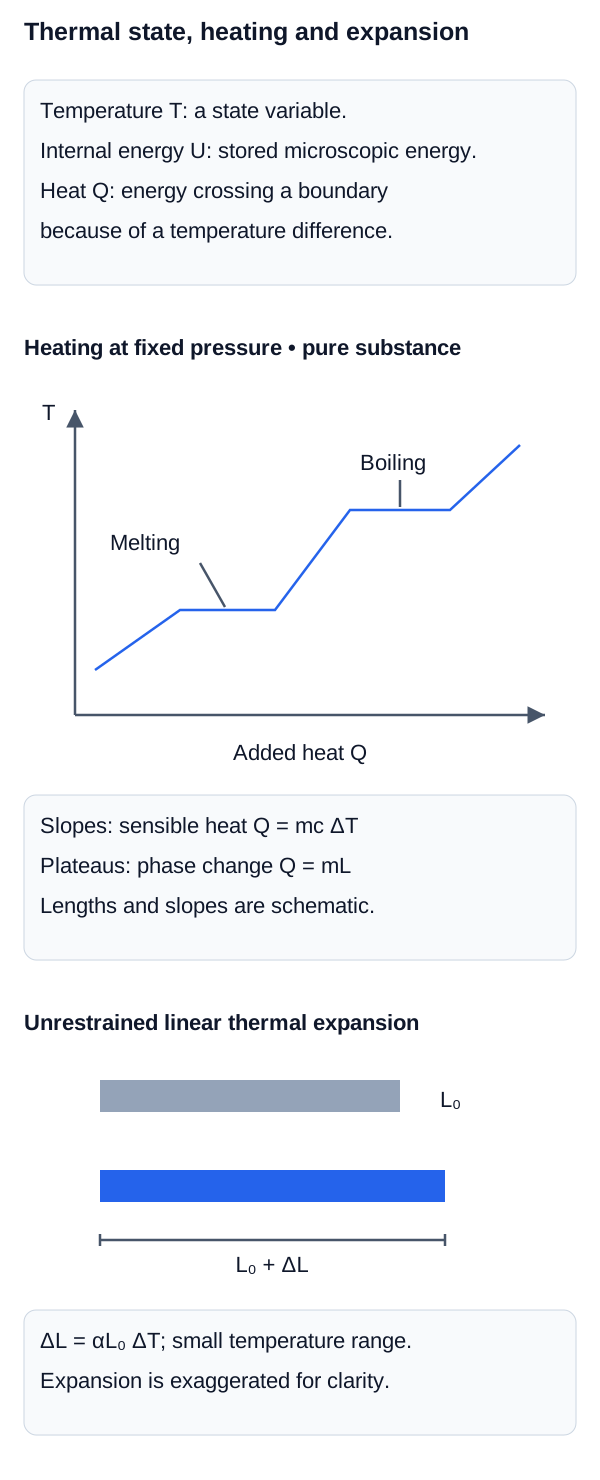
Thermal State, Heating, Phase Change, and Expansion
The panels distinguish state variables from energy transfer, show sensible versus latent heating, and connect temperature change with thermal expansion.
Thermal Expansion and Heat Capacity
Thermal Expansion and Heat Capacity Concepts
Most materials expand when heated and contract when cooled. For solids and liquids, this expansion is typically proportional to the temperature change.
Linear Thermal Expansion
Calculates the change in length of a solid due to a change in temperature.
Variables
| Symbol | Description | Unit |
|---|---|---|
| Change in length | m | |
| Coefficient of linear expansion | ||
| Initial length | m | |
| Change in temperature | K |
Volume Thermal Expansion
Calculates the change in volume of a substance due to a change in temperature.
Variables
| Symbol | Description | Unit |
|---|---|---|
| Change in volume | ||
| Coefficient of volume expansion | ||
| Initial volume | ||
| Change in temperature | K |
Specific Heat Capacity ()
Specific Heat Capacity () Concepts
The amount of heat () required to change the temperature of a substance depends on its mass () and a material property called specific heat capacity.
Specific Heat Equation
Calculates the heat required to change the temperature of a mass.
Variables
| Symbol | Description | Unit |
|---|---|---|
| Heat added or removed | J | |
| Mass | kg | |
| Specific heat capacity | ||
| Change in temperature | K |
Specific Heat Capacity
Water has a very high specific heat (), meaning it takes a lot of energy to change its temperature.
Latent Heat ()
Latent Heat () Concepts
When a substance undergoes a phase change (like melting or boiling), heat is added or removed without any change in temperature. The energy goes into breaking or forming intermolecular bonds.
Latent Heat
Calculates the heat required to change the phase of a substance without changing its temperature.
Variables
| Symbol | Description | Unit |
|---|---|---|
| Heat added or removed | J | |
| Mass of the substance | kg | |
| Latent heat of fusion or vaporization | J/kg |
Mechanisms of Heat Transfer
Mechanisms of Heat Transfer Concepts
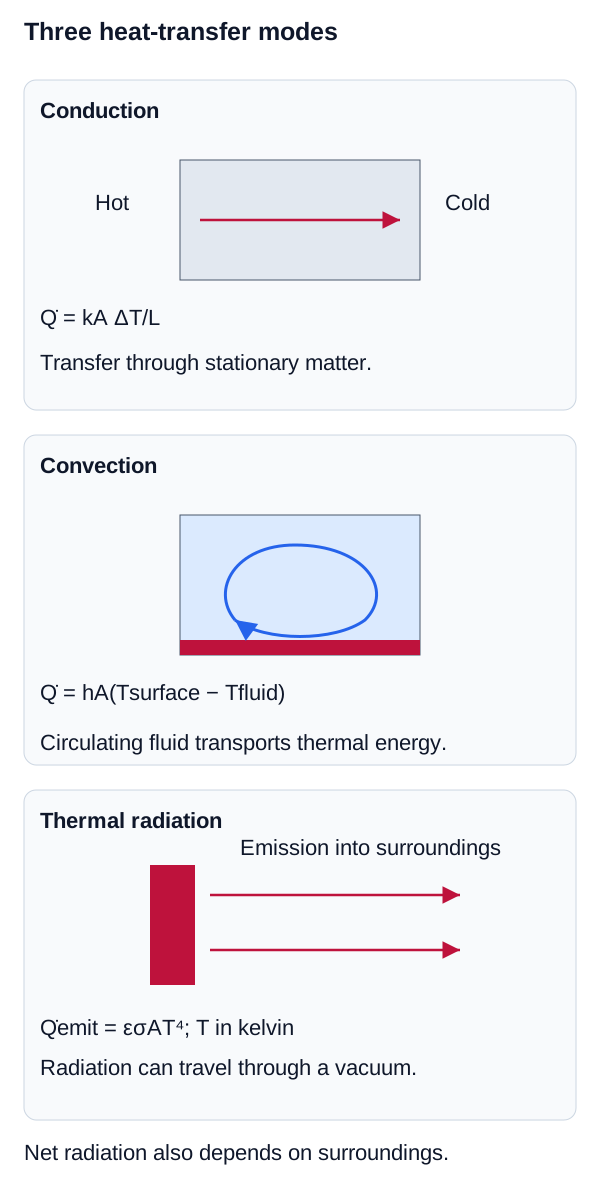
There are three fundamental mechanisms by which heat is transferred:
- Conduction: Heat transfer through stationary matter by physical contact (e.g., a metal spoon getting hot in soup).
- Convection: Heat transfer by the macroscopic movement of a fluid (e.g., hot air rising, water circulating in a pot). Natural convection is driven by buoyant forces, while forced convection uses pumps or fans.
- Radiation: Heat transfer by electromagnetic waves (e.g., feeling the heat from the sun or a fire). Does not require a medium.
Fourier's Law of Heat Conduction
Calculates the rate of heat transfer through a material via conduction.
Variables
| Symbol | Description | Unit |
|---|---|---|
| Rate of heat transfer (Power) | W | |
| Thermal conductivity of the material | ||
| Cross-sectional area | ||
| Temperature difference across the material | ||
| Thickness of the material | m |
Stefan-Boltzmann Law of Radiation
Calculates the thermal-radiation power emitted by a diffuse gray surface.
Variables
| Symbol | Description | Unit |
|---|---|---|
| Radiated power | W | |
| Stefan-Boltzmann constant | ||
| Emissivity of the object | ||
| Surface area | ||
| Absolute temperature | K |
Net Radiation Exchange
The expression above is emitted power. For a small gray surface exchanging radiation with large surroundings at temperature , a common net model is . Geometry and view factors are required for more general radiative exchange.
Civil Engineering Applications of Heat Transfer
- Insulation Sizing: Determining and selecting materials with low to minimize heat loss/gain in buildings.
- Urban Heat Island Effect: Accounting for radiation absorbed and re-emitted by asphalt and concrete surfaces.
- Thermal Stress Analysis: Calculating temperature gradients that cause structural expansion or contraction.
Conduction, Convection, and Radiation
The three panels distinguish transfer through matter, bulk fluid motion, and electromagnetic radiation; real systems can involve all three at once.
The Laws of Thermodynamics
The Laws of Thermodynamics Concepts
These four empirical laws govern all macroscopic interactions involving energy and temperature.
The Zeroth Law: Thermal Equilibrium
The Zeroth Law: Thermal Equilibrium Concepts
If system A is in thermal equilibrium with system C, and system B is also in thermal equilibrium with system C, then system A and system B must be in thermal equilibrium with each other.
This law defines temperature: two systems in thermal equilibrium have the same temperature.
The First Law: Conservation of Energy
The First Law: Conservation of Energy Concepts
The First Law is the principle of conservation of energy applied to thermal systems. It states that the change in a system's internal energy () is equal to the net heat added to the system () minus the net work done by the system on its surroundings ().
The First Law of Thermodynamics
Conservation of energy applied to thermal systems.
Variables
| Symbol | Description | Unit |
|---|---|---|
| Change in internal energy of the system | J | |
| Net heat added to the system | J | |
| Net work done by the system | J |
Sign Conventions for the First Law
Sign conventions are critical here:
- : Heat is added to the system.
- : Heat is removed from the system.
- : Work is done by the system (it expands).
- : Work is done on the system (it is compressed).
Work Done by a Gas
Calculates the work done by a gas expanding or compressing against a pressure.
Variables
| Symbol | Description | Unit |
|---|---|---|
| Work done by the gas | J | |
| Pressure of the gas | Pa | |
| Initial and final volumes |
Work Done on a P-V Diagram
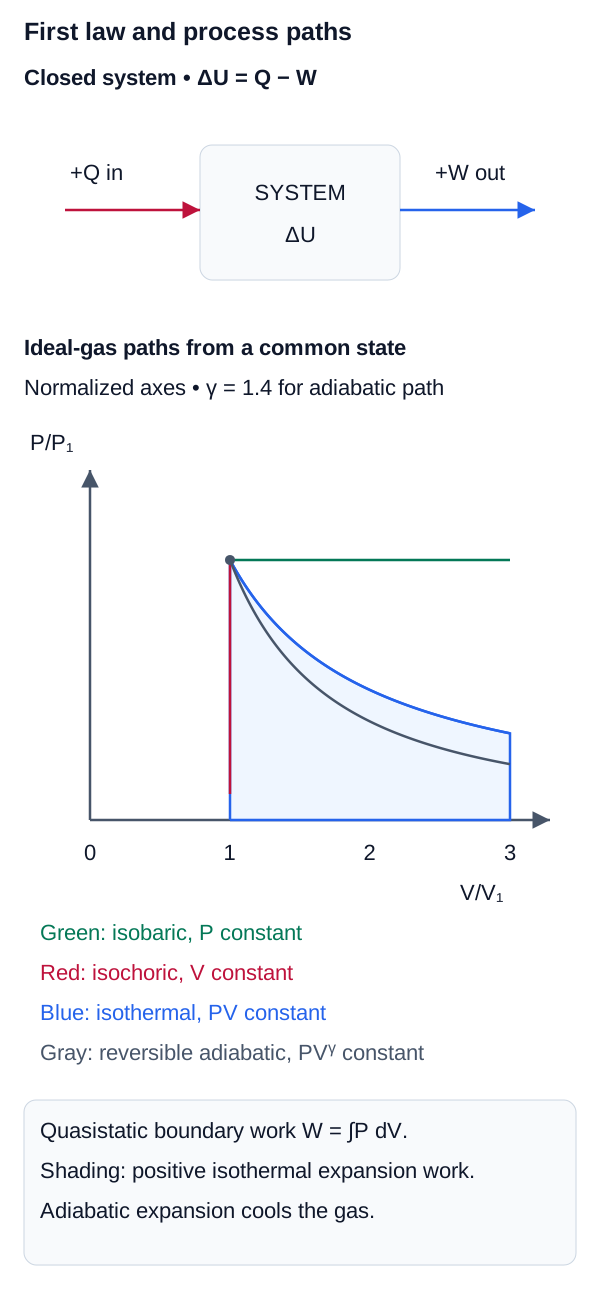
For a quasistatic process, the boundary work done by the gas is the signed area under the process path on a pressure–volume diagram: expansion gives positive work with the sign convention used here, while compression gives negative work.
First Law, P–V Work, and Process Comparison
Heat into the system is positive, work by the system is positive, P–V area is boundary work, and the idealized process paths show their distinct constraints.
Thermodynamic Processes
Thermodynamic Processes Concepts
When a gas changes state (pressure, volume, temperature), it follows a specific process. The First Law applies to all of them, but simplifies uniquely for each:
- Isothermal Process (Constant Temperature): , so (for an ideal gas). Therefore, . Heat added is entirely converted to work done by the gas.
- Isobaric Process (Constant Pressure): . Heat added changes both internal energy and does work.
- Isochoric (Isovolumetric) Process (Constant Volume): , so . Therefore, . All heat added goes into increasing the internal energy.
- Adiabatic Process (No Heat Transfer): . Therefore, . If the gas expands and does work, its internal energy (and thus temperature) must decrease.
Interactive Simulation
Select Carnot, Otto, or Brayton. Every state label, P–V coordinate, heat/work value, animation point, and efficiency comes from one canonical ideal-gas state model for the selected cycle.
Q=13,831.6 J; W=13,831.6 J
The Second Law: Entropy and Direction
The Second Law: Entropy and Direction Concepts
The First Law says energy is conserved, but it doesn't restrict the direction of energy transfer. The Second Law dictates that direction. There are several equivalent statements of the Second Law:
- Clausius Statement: Heat can never pass spontaneously from a colder body to a warmer body.
- Kelvin-Planck Statement: It is impossible to construct a heat engine that, operating in a cycle, extracts heat from a single reservoir and converts it entirely into work. Some heat must be expelled to a colder sink. (No engine is 100% efficient).
- Entropy Statement: The total entropy () of an isolated system can never decrease over time. .
Entropy ()
A thermodynamic state function related statistically to the number of microscopic configurations compatible with a macroscopic state. For a reversible transfer, ; for an isolated system, the Second Law requires total entropy not to decrease.
Heat Engines and Efficiency
Heat Engines and Efficiency Concepts
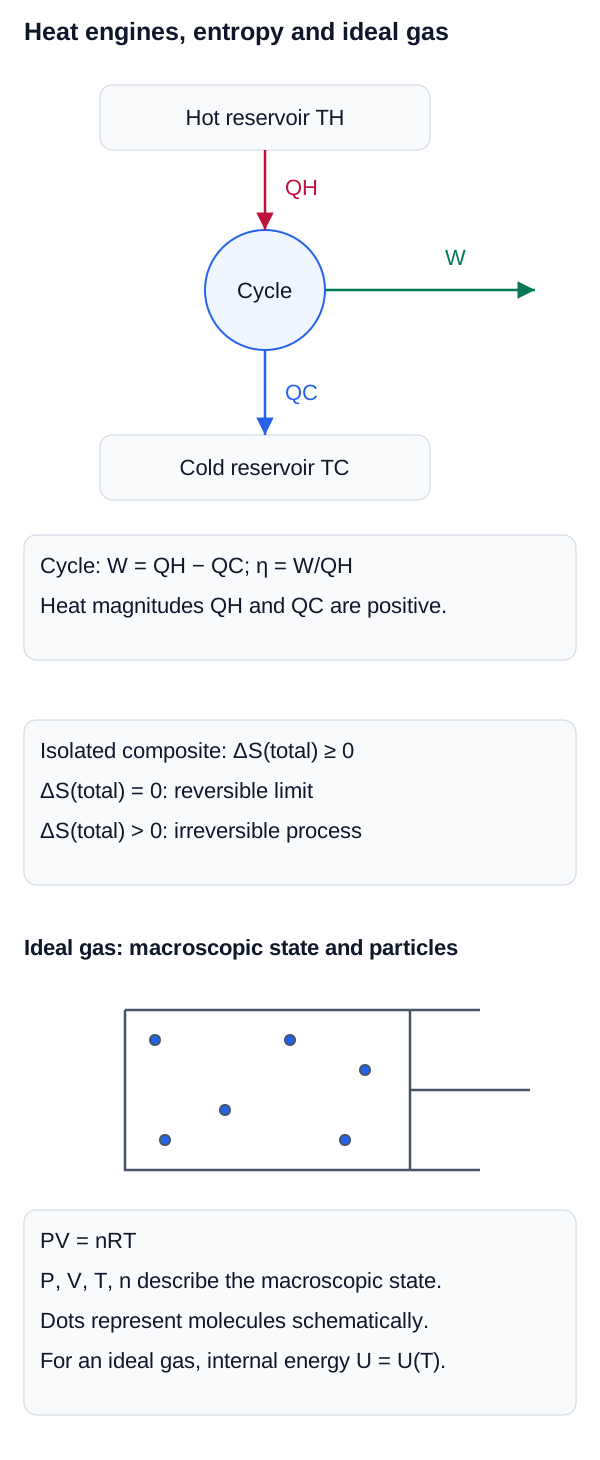
A heat engine is a device that extracts heat () from a hot reservoir, uses some of it to do useful work (), and exhausts the remaining waste heat () to a cold reservoir.
By the First Law, .
The thermal efficiency () is the ratio of what you get to what you pay for:
Thermal Efficiency of a Heat Engine
Calculates the efficiency of a heat engine based on work output and heat input.
Variables
| Symbol | Description | Unit |
|---|---|---|
| Thermal efficiency | dimensionless | |
| Useful work done by the engine | J | |
| Heat extracted from the hot reservoir | J | |
| Heat exhausted to the cold reservoir | J |
Heat Engines and Efficiency Concepts
The Carnot Engine is an idealized, reversible engine that sets the maximum possible theoretical efficiency between two temperatures:
Carnot Efficiency
Sets the maximum theoretical efficiency for any heat engine operating between two temperatures.
Variables
| Symbol | Description | Unit |
|---|---|---|
| Maximum theoretical efficiency | dimensionless | |
| Absolute temperature of the cold reservoir | K | |
| Absolute temperature of the hot reservoir | K |
Heat Engines, Entropy, and the Ideal-Gas Model
The panels show required heat rejection, the nonnegative isolated-system entropy balance, and the distinction between the ideal-gas equation of state and a schematic particle interpretation.
The Third Law: Absolute Zero
The Third Law: Absolute Zero Concepts
For a perfect crystal with a unique ground state, entropy approaches zero as temperature approaches absolute zero. A related unattainability statement is that absolute zero cannot be reached by a finite sequence of thermodynamic operations.
The Ideal Gas Law and Kinetic Theory
Macroscopic vs. Microscopic
The Ideal Gas Law () relates the macroscopic properties of a gas: pressure, volume, temperature, and amount of substance.
The Kinetic Theory of Gases provides the microscopic explanation for these macroscopic properties. It models a gas as a large number of tiny, rapidly moving particles in random, continuous motion, colliding elastically with each other and the container walls. The pressure exerted by a gas is the macroscopic result of billions of microscopic particle collisions against the container.
The Ideal Gas Law
The equation of state for a hypothetical ideal gas.
Variables
| Symbol | Description | Unit |
|---|---|---|
| Absolute pressure | Pa | |
| Volume | ||
| Number of moles | mol | |
| Universal gas constant | ||
| Absolute temperature | K | |
| Number of molecules | dimensionless count | |
| Boltzmann constant | J/K |
Interactive Simulation
Change amount, absolute temperature, volume, and gas species. Pressure follows exactly. Particle motion is a deterministic illustration whose speed scale follows the ideal-gas rms trend; it is not a molecular-dynamics solver.
- Temperature () is a thermodynamic state variable; in the ideal-gas kinetic model it is related to average molecular kinetic energy. Heat () is energy transferred because of a temperature difference.
- Heat transfer mechanisms are Conduction (contact), Convection (fluid motion), and Radiation (electromagnetic waves).
- Specific heat () relates to ; Latent heat () relates to phase changes without .
- Zeroth Law: Defines temperature via thermal equilibrium.
- First Law: Conservation of energy ().
- Second Law: Dictates the direction of processes (heat flows hot to cold) and introduces Entropy; the total entropy of an isolated system cannot decrease. A cyclic heat engine cannot convert all absorbed heat into work.
References
- OpenStax University Physics Volume 2 — Temperature and Heat
- OpenStax University Physics Volume 2 — First Law of Thermodynamics
- OpenStax University Physics Volume 2 — Thermodynamic Processes
- OpenStax University Physics Volume 2 — Statements of the Second Law
- BIPM — SI Brochure
- NIST — CODATA Values of the Fundamental Physical Constants