Work, Energy, and Power
Learning Objectives
- Define work, kinetic energy, potential energy, and power.
- Calculate the work done by constant and variable forces.
- Apply the Work-Energy Theorem to relate net work to changes in kinetic energy.
- Distinguish between conservative and non-conservative forces.
- Use the principle of Conservation of Mechanical Energy to solve mechanics problems.
- Calculate power output and mechanical efficiency for engineering systems.
Work: The Transfer of Energy
Work: The Transfer of Energy Concepts
In physics, "work" has a very specific meaning. It is the transfer of energy to or from an object via the application of force along a displacement.
Work ()
The scalar product (dot product) of the force vector and the displacement vector. It represents the component of force acting in the direction of motion. The SI unit of work is the Joule (J), where .
Work done by a Constant Force
Work done by a Constant Force Concepts
If a constant force is applied to an object that undergoes a straight-line displacement , the work done by that force is:
Work done by a Constant Force
Calculates the work done by a constant force acting over a straight-line displacement.
Variables
| Symbol | Description | Unit |
|---|---|---|
| Work done | J | |
| Constant force vector | N | |
| Displacement vector | m | |
| Angle between force and displacement vectors |
Sign of Work Done
Work can be positive, negative, or zero:
- Positive Work (): The force is helping the motion, adding energy to the system.
- Zero Work (): The force is perpendicular to the motion (e.g., normal force on a level surface). It transfers no energy.
- Negative Work (): The force is opposing the motion (e.g., kinetic friction), removing energy from the system.
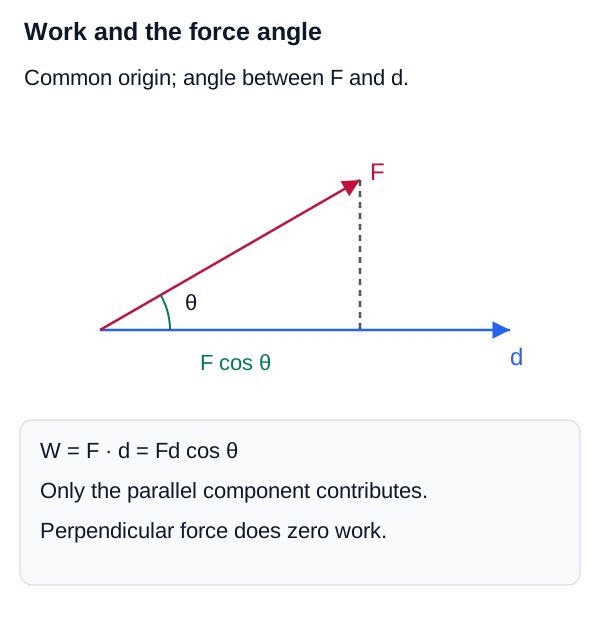
Work and force-angle visual
Work as a force-displacement dot product
The projection F cos theta is the part of the force that transfers energy through the displacement.
Work done by a Variable Force
Work done by a Variable Force Concepts
If the force changes magnitude or direction as the object moves, we must use calculus to find the work done. Work is the integral of the force along the path of motion.
Work done by a Variable Force
Calculates the work done by a variable force along a 1D path.
Variables
| Symbol | Description | Unit |
|---|---|---|
| Work done | J | |
| Variable force as a function of position | N | |
| Initial position | m | |
| Final position | m |
Work done by a Variable Force Concepts
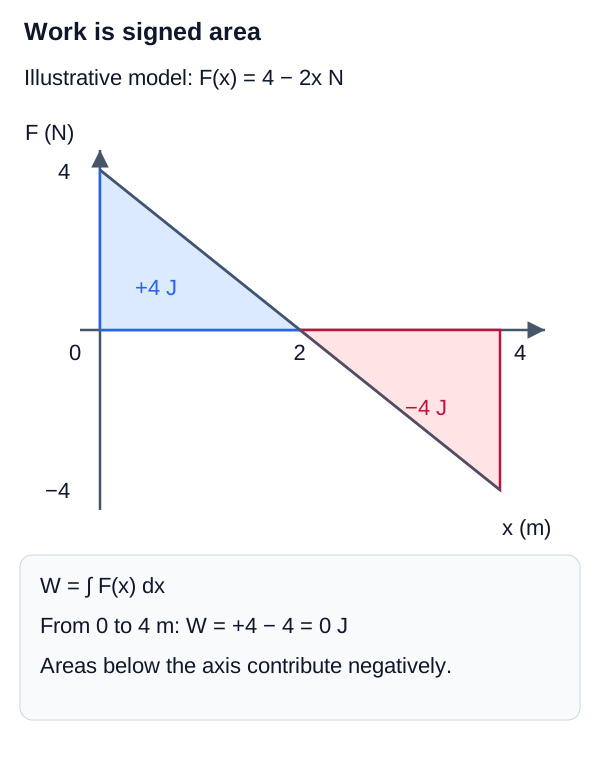
Graphically, this represents the area under the Force vs. Position curve.
Variable-force work visual
Work from an F-x graph
The integral of force with respect to displacement gives work; regions below the axis contribute negative work.
Kinetic Energy and the Work-Energy Theorem
Kinetic Energy and the Work-Energy Theorem Concepts
Energy is the capacity to do work. The most basic form of mechanical energy is associated with motion.
Kinetic Energy ()
The energy an object possesses due to its motion. It is a scalar quantity (always positive or zero). The SI unit is the Joule (J).
Kinetic Energy
Calculates the translational kinetic energy of an object.
Variables
| Symbol | Description | Unit |
|---|---|---|
| Kinetic energy | J | |
| Mass of the object | kg | |
| Speed of the object |
Kinetic Energy and the Work-Energy Theorem Concepts
The connection between work and kinetic energy is codified in one of the most important theorems in mechanics.
The Work-Energy Theorem
The net work done by all forces acting on an object equals the change in its kinetic energy.
The Work-Energy Theorem
Relates the net work done on an object to its change in kinetic energy.
Variables
| Symbol | Description | Unit |
|---|---|---|
| Net work done on the object | J | |
| Change in kinetic energy | J | |
| Final kinetic energy | J | |
| Initial kinetic energy | J | |
| Mass of the object | kg | |
| Final speed | ||
| Initial speed |
Kinetic Energy and the Work-Energy Theorem Concepts
This theorem provides a powerful shortcut. If you know the initial and final speeds and the mass, you immediately know the total work done on the object, regardless of what forces were involved or the path taken.
Potential Energy and Conservative Forces
Potential Energy and Conservative Forces Concepts
Some forces, like gravity or an ideal spring, allow us to "store" work done as energy that can be recovered later. These are called conservative forces.
Conservative Force
A force is conservative if the work it does on an object moving between two points is independent of the path taken. Equivalently, the work done by a conservative force on an object moving around any closed path is zero. Examples: Gravity, Electrostatic force, Spring force.
Non-Conservative Force
A force for which the work between two states cannot be represented by a single position-only potential-energy function. Such interactions can transfer mechanical energy into internal, thermal, acoustic, or other forms. Examples: kinetic friction and aerodynamic drag.
Potential Energy and Conservative Forces Concepts
For every conservative force, we can define a corresponding potential energy function ().
Potential Energy ()
Energy associated with the spatial configuration of a system of objects interacting via conservative forces. The change in potential energy is defined as the negative of the work done by the conservative force.
Change in Potential Energy
Defines the change in potential energy as the negative work done by a conservative force.
Variables
| Symbol | Description | Unit |
|---|---|---|
| Change in potential energy | J | |
| Work done by conservative force | J | |
| Conservative force vector | N | |
| Differential displacement vector | m |
Force from Potential Energy
Force from Potential Energy Concepts
Because the change in potential energy is the negative work done by a conservative force (), we can reverse this relationship. If we know the potential energy function , we can find the conservative force by taking the negative derivative:
Force from Potential Energy
Calculates the 1D conservative force as the negative derivative of the potential energy function.
Variables
| Symbol | Description | Unit |
|---|---|---|
| Conservative force in x-direction | N | |
| Potential energy function | J | |
| Position | m |
Force from Potential Energy Concepts
In three dimensions, the conservative force vector is the negative gradient of the potential energy field: . This tells us that forces naturally push objects towards regions of lower potential energy.
Common Forms of Potential Energy
Common Forms of Potential Energy Concepts
- Gravitational Potential Energy (): Near the Earth's surface, , where is the height above a chosen reference level ().
- Elastic Potential Energy (): Stored in a compressed or stretched spring following Hooke's Law (). , where is the displacement from equilibrium.
Conservation of Mechanical Energy
Conservation of Mechanical Energy Concepts
The total mechanical energy () of a system is the sum of its kinetic and potential energies: .
If only conservative forces do work on a system, the total mechanical energy is conserved (remains constant).
Conservation of Mechanical Energy
If only conservative forces do work on a system, the total mechanical energy is conserved (remains constant).
Conservation of Mechanical Energy
States that total mechanical energy remains constant when only conservative forces act.
Variables
| Symbol | Description | Unit |
|---|---|---|
| Total mechanical energy | J | |
| Kinetic energy | J | |
| Gravitational potential energy | J | |
| Elastic potential energy | J | |
| Initial state | - | |
| Final state | - |
Interactive Simulation: Conservation of Energy
Use this energy model to watch kinetic and potential energy trade places while total mechanical energy stays tracked.
Energy Diagnostic Chart
Conservation of Mechanical Energy Concepts
If non-conservative forces (like friction) do work, the mechanical energy changes by an amount equal to that work:
Work Done by Non-Conservative Forces
Calculates the change in mechanical energy caused by non-conservative forces.
Variables
| Symbol | Description | Unit |
|---|---|---|
| Work done by non-conservative forces | J | |
| Change in total mechanical energy | J | |
| Final total mechanical energy | J | |
| Initial total mechanical energy | J |
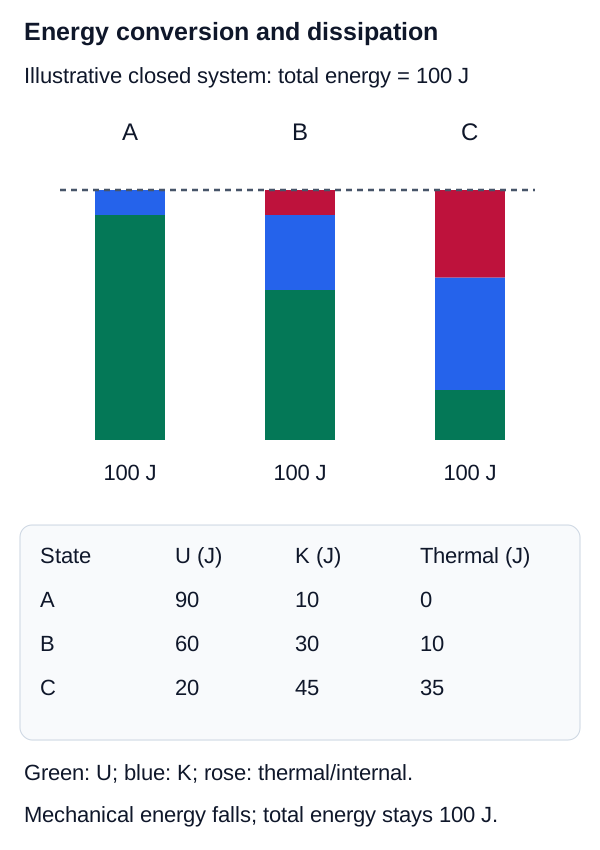
Energy-transfer visual
Energy transfer and dissipation
A stacked energy view makes conversion and dissipation explicit without implying that thermal energy disappears.
Power
Power Concepts
While work tells us how much energy was transferred, power tells us how fast it was transferred. In engineering (e.g., designing motors or engines), power is often the critical limiting factor.
Power ()
The rate at which work is done or energy is transferred. The SI unit is the Watt (W), where .
Average and Instantaneous Power
Calculates the rate of energy transfer or work done.
Variables
| Symbol | Description | Unit |
|---|---|---|
| Average power | W | |
| Instantaneous power | W | |
| Work done | J | |
| Energy transferred | J | |
| Time interval | s |
Power Concepts
For a constant force acting on an object moving with velocity , instantaneous power can be written as:
Instantaneous Power from Force and Velocity
Calculates instantaneous power when a constant force is applied to an object moving at a certain velocity.
Variables
| Symbol | Description | Unit |
|---|---|---|
| Instantaneous power | W | |
| Force vector | N | |
| Velocity vector |
Interactive Simulation: Power and Work Rate
Adjust force, displacement, time, and force direction to connect work transfer with power demand.
Efficiency ()
Efficiency () Concepts
No real machine converts all input energy into the intended useful output. Part of the input is transferred into non-useful forms such as thermal energy, vibration, or sound. Mechanical efficiency is the ratio of useful power output to total power input.
Mechanical Efficiency
Calculates the ratio of useful power or work output to the total input.
Variables
| Symbol | Description | Unit |
|---|---|---|
| Mechanical efficiency | - | |
| Useful power output | W | |
| Total power input | W | |
| Useful work output | J | |
| Total work input | J |
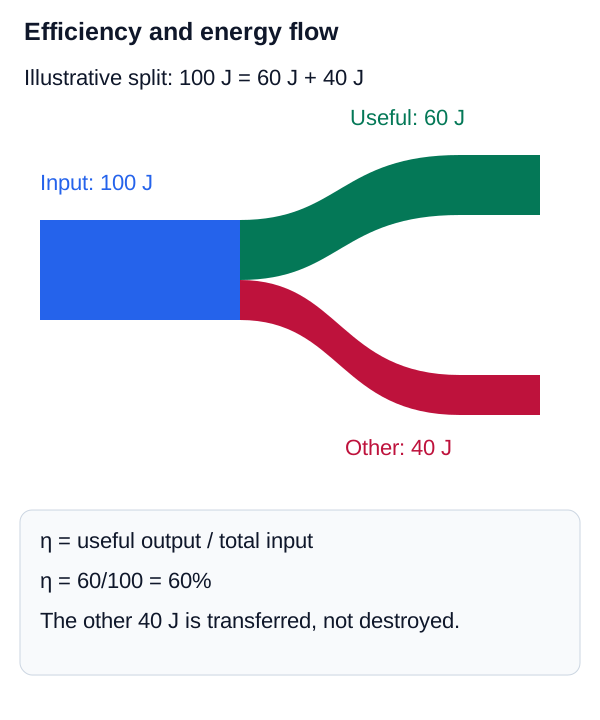
Efficiency visual
Efficiency as an energy-flow ratio
The useful branch divided by the total input gives efficiency, while the loss branch accounts for non-useful transfers.
Non-Conservative Forces and Dissipation
The Role of Friction
While conservative forces (like gravity and ideal springs) allow mechanical energy to be stored and perfectly recovered, non-conservative forces act differently. The most common non-conservative force in mechanical engineering is friction.
Kinetic friction opposes relative sliding at the contact. Its work on a selected body is negative when the friction force is opposite that body's displacement, as in the sliding-block cases used here; in other systems, such as a moving belt accelerating an object, friction can do positive work on that object.
Work Done by Kinetic Friction
Calculates friction work for the common case where kinetic friction is opposite the displacement.
Variables
| Symbol | Description | Unit |
|---|---|---|
| Work done by friction | J | |
| Kinetic friction force | N | |
| Distance traveled | m | |
| Coefficient of kinetic friction | - | |
| Normal force | N |
- Work () is energy transferred by a force acting over a distance. Positive work adds energy; negative work removes it.
- The Work-Energy Theorem states that net work equals the change in kinetic energy ().
- Conservative forces (gravity, springs) allow the definition of Potential Energy ().
- Mechanical Energy () is conserved if only conservative forces do work. If friction is present, .
- Power is the rate of doing work or transferring energy ().