Deflection of Structures - Theory & Concepts
Learning Objectives
- Understand the fundamental principles governing beam deflection.
- Apply geometric methods such as the Double Integration Method, Moment-Area Method, and Conjugate Beam Method.
- Apply energy methods including Virtual Work (Unit Load Method) and Castigliano's Theorems.
- Understand and apply Maxwell-Betti's Reciprocal Theorem.
Deflection is the displacement of a structural element under load. Controlling deflection is critical for ensuring the serviceability (usability and comfort) of a structure, preventing damage to non-structural elements (partitions, ceilings), and ensuring visual acceptability.
Fundamental Principles
The relationship between load, shear, moment, slope, and deflection is governed by differential equations derived from beam theory.
Beam Deflection Relationships
The fundamental differential equations relating load, shear, moment, slope, and deflection.
Variables
| Symbol | Description | Unit |
|---|---|---|
| Modulus of Elasticity | - | |
| Moment of Inertia | - | |
| Flexural Rigidity | - | |
| Deflection | - | |
| Load | - | |
| Shear | - | |
| Moment | - | |
| Slope | - |
Interactive Simulation
Explore how load, length, and material properties affect beam deflection with this interactive tool:
Geometric Methods
These methods rely on the geometry of the elastic curve (deflected shape).
The Double Integration Method
The Double Integration Method involves solving the governing differential equation for the elastic curve of a beam to find expressions for its slope and deflection everywhere along its length.
Integration Process
Sign Convention: A positive internal moment causes the beam to bend concave upwards (like a smile). In this standard coordinate system, a positive deflection indicates an upward displacement, and a negative deflection indicates a downward displacement.
- First Integration: Integrating the equation once yields the equation for the slope () of the elastic curve, plus a constant of integration ().
- Second Integration: Integrating a second time yields the equation for the deflection (), plus another constant ().
- Boundary Conditions: To solve for the constants and , the known geometric boundary conditions of the beam's supports are applied (e.g., at a fixed support, deflection and slope ; at a pin or roller, deflection ).
Governing Differential Equation
The foundational relationship between bending moment and deflection derived from beam theory.
Variables
| Symbol | Description | Unit |
|---|---|---|
| Modulus of elasticity | - | |
| Moment of inertia | - | |
| Vertical deflection | - | |
| Position along the beam | - | |
| Internal bending moment expressed as a function of | - |
First Integration (Slope)
Equation for the slope of the elastic curve.
Variables
| Symbol | Description | Unit |
|---|---|---|
| First constant of integration | - |
Second Integration (Deflection)
Equation for the deflection of the elastic curve.
Variables
| Symbol | Description | Unit |
|---|---|---|
| Second constant of integration | - |
Macaulay's Method (Singularity Functions)
For beams with multiple loads, the internal moment changes equations at every load point. Macaulay's Method uses singularity functions (Macaulay brackets, e.g., ) to write a single, continuous equation for valid across the entire beam length. This reduces the number of integration constants from (where is the number of beam segments) down to just 2 for the whole beam, drastically simplifying the double integration process.
Moment-Area Method
Based on two theorems relating the area of the diagram to changes in slope and deflection.
First Moment-Area Theorem
The change in slope between any two points on the elastic curve equals the area of the diagram between those points.
First Moment-Area Theorem Equation
Change in slope between points A and B.
Variables
| Symbol | Description | Unit |
|---|---|---|
| Change in slope between point A and point B | - | |
| Internal bending moment | - | |
| Modulus of elasticity | - | |
| Moment of inertia | - |
Second Moment-Area Theorem
The vertical deviation of point B on the elastic curve from the tangent drawn at point A equals the moment of the area of the diagram between A and B, taken about B.
Second Moment-Area Theorem Equation
Vertical deviation of point B from tangent drawn at point A.
Variables
| Symbol | Description | Unit |
|---|---|---|
| Vertical deviation of B with respect to the tangent at A | - | |
| Internal bending moment | - | |
| Modulus of elasticity | - | |
| Moment of inertia | - | |
| Distance from the moment center (point B) | - |
Conjugate Beam Method
Transforms the real beam into a fictitious "conjugate beam" loaded with the diagram of the real beam.
Conjugate Beam Correspondences
- Slope on real beam Shear on conjugate beam.
- Deflection on real beam Moment on conjugate beam.
Interactive Simulation
Use this interactive tool to explore the Conjugate Beam Method:
Adjust the load position to see how the M/EI diagram becomes the load for the Conjugate Beam.
Real Beam (Point Load)
Conjugate Beam (M/EI Load)
Energy Methods
Based on the principle of conservation of energy (Work Done = Strain Energy Stored). These are incredibly versatile methods applicable to all structural types.
Virtual Work (Unit Load Method)
A powerful and versatile method applicable to beams, frames, and trusses.
Virtual Work Procedure
- To find deflection at a point, apply a virtual unit load at that point in the direction of the desired displacement.
- Calculate internal virtual forces () due to the unit load, and calculate real internal forces () due to actual loads.
Virtual Work Equation (Beams)
Calculates deflection using virtual work.
Variables
| Symbol | Description | Unit |
|---|---|---|
| Deflection | - | |
| Real moment function | - | |
| Virtual moment function due to unit load | - | |
| Modulus of elasticity | - | |
| Moment of inertia | - |
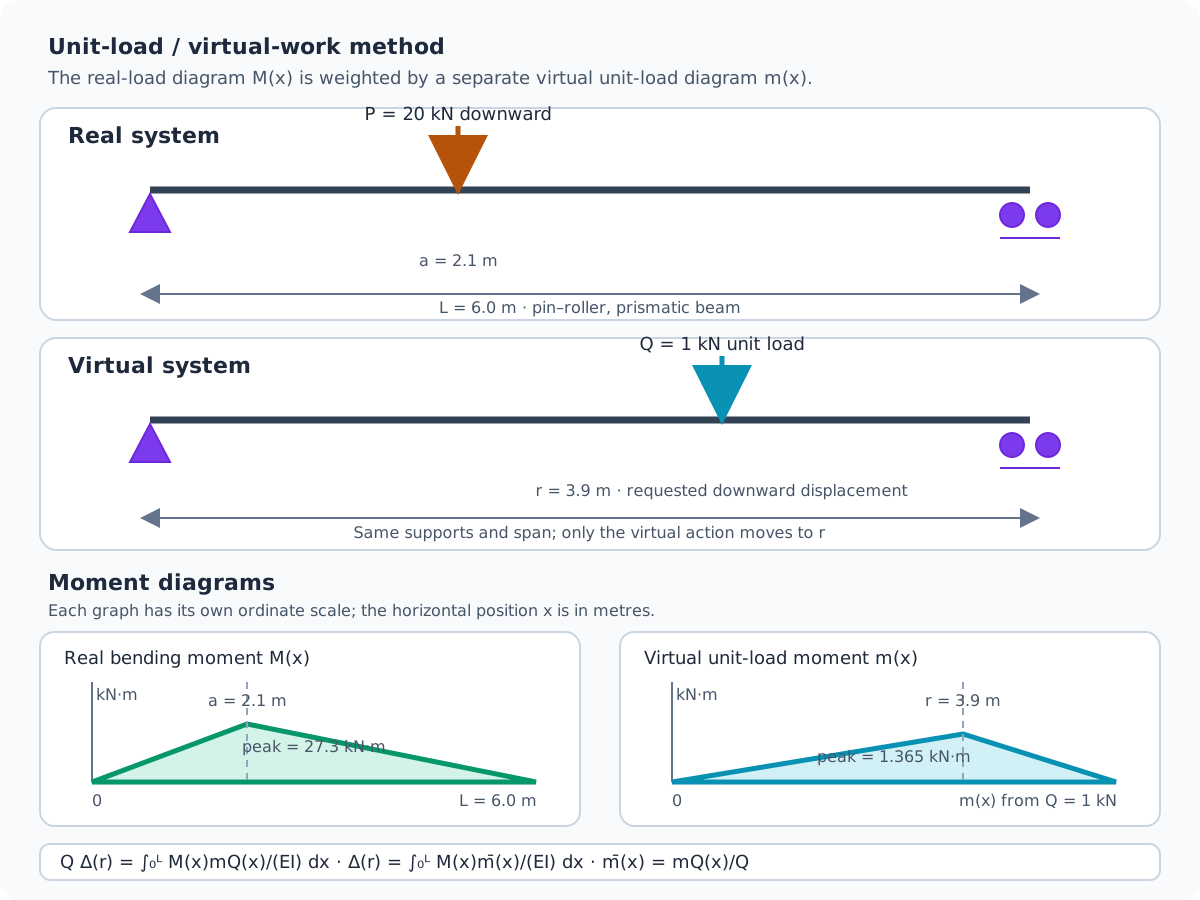
Unit-load method: real and virtual moment diagrams
The real-load moment diagram M(x) and the virtual unit-load diagram m(x) are multiplied and integrated over EI to obtain the displacement at response location r. The physical beam sketches use a six-metre span; the graphs are explicitly separate, independently scaled plots.
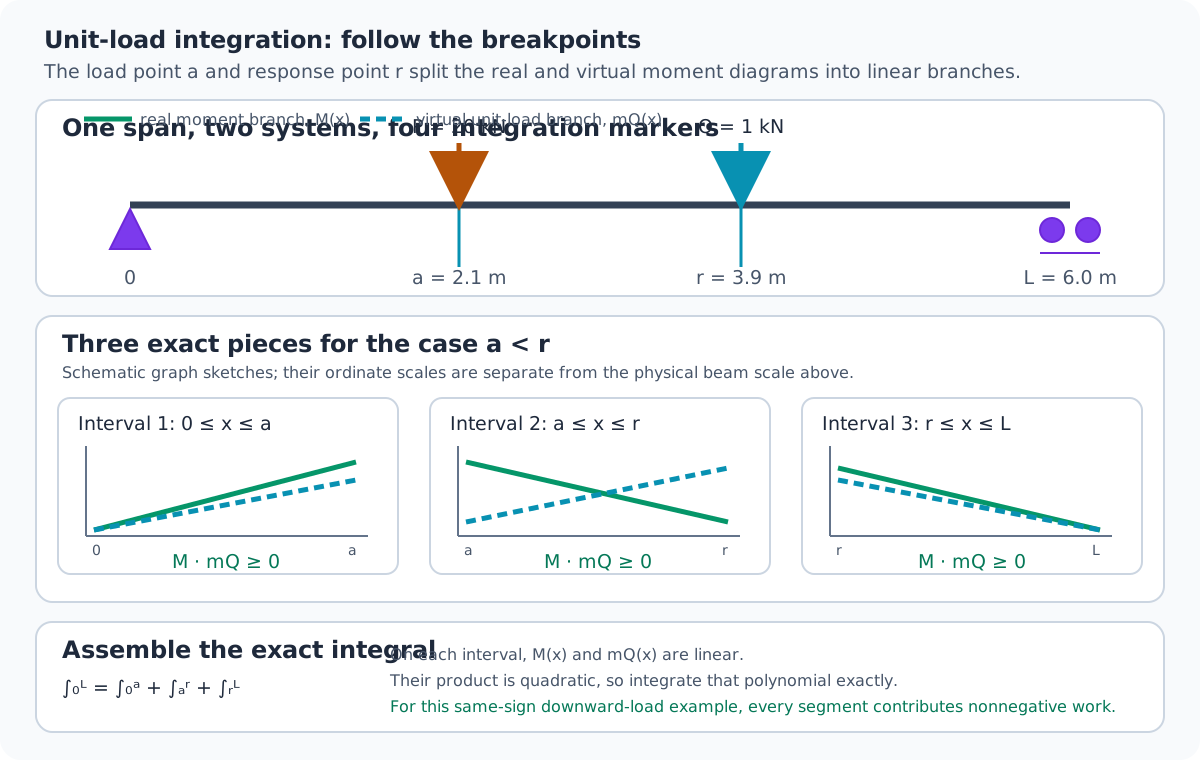
Piecewise integration segments for the unit-load method
For the illustrative case where the real load point a lies left of response point r, the four span markers divide the diagrams into three intervals. On each interval the real and virtual moment branches are linear, so their product is integrated exactly as a quadratic polynomial.
Interactive Unit-Load Deflection Simulation
Use the simulation to move the real point load and the response location independently. Read how the exact piecewise integral of changes when the virtual unit load moves, while and control flexural rigidity.
Beam and material controls
The virtual bending-moment diagram is generated by the one-kilonewton action at the response location. The reported displacement divides the internal virtual work by that action.
Exact integration method
On each of 3 intervals, and are linear. Their product is integrated as a quadratic polynomial; the only numerical limitation is floating-point round-off.
Real-load moment diagram; peak = 27.30 kN·m.
Virtual unit-load moment diagram; peak = 1.36 kN·m.
The reported displacement equals internal virtual work divided by the one-kilonewton virtual action.
The converted modulus and section inertia are multiplied to form flexural rigidity.
Internal virtual work evaluated from the exact piecewise integral.
The real point load is at 2.10 m.
The normalized form uses . Moving the response location changes only the virtual diagram, so its overlap with the real diagram explains the change in displacement.
Castigliano's Theorems
Alberto Castigliano formulated two essential theorems using partial derivatives of strain energy to find displacements and forces.
Castigliano's First Theorem Context
For a linearly elastic structure, the partial derivative of the total strain energy () with respect to a specific displacement () gives the applied force () corresponding to that displacement.
Note: This theorem is primarily used in advanced structural mechanics to formulate stiffness matrices.
Castigliano's First Theorem
Finds applied force from strain energy.
Variables
| Symbol | Description | Unit |
|---|---|---|
| Applied force | - | |
| Total strain energy | - | |
| Displacement at point of application | - |
Castigliano's Second Theorem Context
For a linearly elastic structure, the partial derivative of the total strain energy () with respect to an applied force () is equal to the displacement () at the point of application and in the specific direction of that force.
Note: This is the theorem most frequently used by engineers to calculate deflections. For example, for a beam subject to bending, , thus .
Castigliano's Second Theorem
Finds displacement from strain energy.
Variables
| Symbol | Description | Unit |
|---|---|---|
| Displacement at point of application | - | |
| Total strain energy | - | |
| Applied force | - |
Maxwell-Betti's Reciprocal Theorem
The reciprocal theorem establishes a profound symmetry in linear elastic structures.
Betti's Law
A general theorem which states that the virtual work done by a first set of forces () moving through the actual displacements caused by a second set of forces () is equal to the virtual work done by the second set of forces () moving through the actual displacements caused by the first set of forces ().
Betti's Law Equation
Equality of virtual work done by reciprocal forces.
Variables
| Symbol | Description | Unit |
|---|---|---|
| First set of forces | - | |
| Actual displacements caused by second set of forces | - | |
| Second set of forces | - | |
| Actual displacements caused by first set of forces | - |
Maxwell's Reciprocal Theorem
A special, simplified case of Betti's Law where both sets of forces are single unit loads (, ). It states that the displacement at point A due to a unit load applied at point B is exactly equal to the displacement at point B due to a unit load applied at point A.
For linear-elastic conservative reciprocal structural systems under the usual stiffness-method assumptions, the stiffness matrix () and corresponding flexibility matrix (, when it exists) are symmetric about the main diagonal.
Maxwell's Reciprocal Theorem Equation
Reciprocal displacement for unit loads.
Variables
| Symbol | Description | Unit |
|---|---|---|
| Displacement at A due to unit load at B | - | |
| Displacement at B due to unit load at A | - |
- Deflection () is a crucial check for serviceability limit states, ensuring structures remain functional and undamaged under regular use.
- The governing differential equations form the basis of calculation methods like double integration. The sign convention (usually positive upwards) must be strictly maintained.
- Moment-Area Method uses geometric properties of the diagram (best for prismatic beams with simple loadings).
- Conjugate Beam Method simplifies deflection calculations by transforming them into basic statics problems (finding internal moment on a fictitious beam).
- Energy Methods leverage the principle of conservation of energy to determine deflections efficiently, especially for complex geometries like trusses and frames.
- Virtual Work (Unit Load) is the most versatile deflection method.
- Castigliano's Second Theorem calculates displacements directly by taking the partial derivative of the strain energy equation with respect to an applied point load.