Measurement and Vectors
Learning Objectives
- Understand physical quantities and the SI system of units in the context of civil engineering.
- Apply dimensional analysis to verify complex structural engineering equations.
- Comprehend the concepts of measurement uncertainty, precision, and significant figures.
- Differentiate between scalar and vector quantities.
- Master vector addition and decomposition using the component method.
- Learn and apply vector multiplication (dot and cross products) to analyze mechanical work and torque.
Introduction to Physical Quantities
Physical Quantity
A physical quantity is a property of a material or system that can be quantified by measurement.
Introduction to Physical Quantities Concepts
In engineering and physics, precision is not a luxury; it is a fundamental requirement. Whether designing a suspension bridge or a microchip, understanding the physical dimensions and directions of forces is what separates a stable design from a catastrophic failure. The description of any physical phenomenon requires measurements.
Units and the SI System
Units and the SI System Concepts
The International System of Units (SI) is the modern metric system and the standard system used in physics and engineering globally. Having a consistent set of units is essential for clear communication and preventing disastrous engineering failures (e.g., the Mars Climate Orbiter crash due to mixed units). In structural design, ensuring all forces are in Newtons and all dimensions in meters before calculation is a crucial habit.
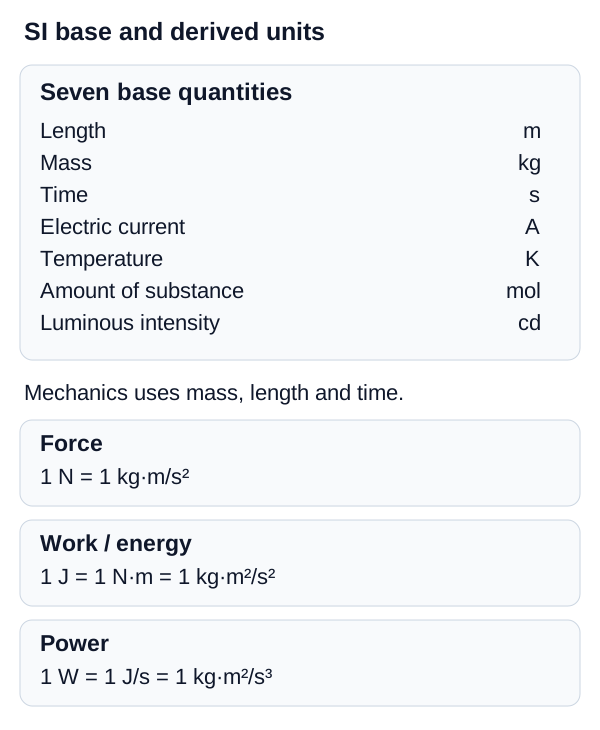
The Seven SI Base Units
SI quantity map
SI base and derived quantities
The newton, joule, and watt are algebraic combinations of SI base units rather than independent measurement systems.
Derived Units
Derived Units Concepts
All other physical quantities can be expressed as algebraic combinations of these base units. Two critical derived units frequently used in physics and structural engineering are the Newton (for force) and the Joule (for energy/work).
Newton (SI Derived Unit for Force)
The Newton is defined as the force required to accelerate a mass of one kilogram at a rate of one meter per second squared.
Variables
| Symbol | Description | Unit |
|---|---|---|
| Newton (SI unit of force) | N | |
| Kilogram (SI base unit of mass) | kg | |
| Meter (SI base unit of length) | m | |
| Second (SI base unit of time) | s |
Joule (SI Derived Unit for Energy)
The Joule is defined as the work done by a force of one Newton acting through a displacement of one meter.
Variables
| Symbol | Description | Unit |
|---|---|---|
| Joule (SI unit of energy/work) | J | |
| Newton (SI unit of force) | N | |
| Meter (SI base unit of length) | m | |
| Kilogram (SI base unit of mass) | kg | |
| Second (SI base unit of time) | s |
Dimensional Analysis
Dimensional Analysis
Dimensional Analysis is a mathematical tool used to check the consistency of equations and convert between different units. It treats units as algebraic quantities.
Dimensional Analysis Concepts
Dimensional formulas represent physical quantities in terms of the fundamental dimensions: Mass (), Length (), and Time (). Every mechanical quantity can be reduced to a specific combination of these dimensions.
Dimensions of Velocity
Velocity is defined as distance over time, yielding dimensions of length per unit time.
Variables
| Symbol | Description | Unit |
|---|---|---|
| Dimensions of velocity | varies | |
| Length dimension | m | |
| Time dimension | s |
Dimensions of Force
Based on Newton's Second Law (), force is the product of mass and acceleration, yielding mass times length per time squared.
Variables
| Symbol | Description | Unit |
|---|---|---|
| Dimensions of force | varies | |
| Mass dimension | kg | |
| Length dimension | m | |
| Time dimension | s |
Principle of Dimensional Homogeneity
You can only add, subtract, or equate quantities that have the exact same dimensions. This is a powerful tool to verify if a derived formula is physically possible.
Interactive Simulation
Use this dimensional checker to test whether a proposed expression can physically represent force before trusting the algebra.
Uncertainty and Significant Figures
Systematic Error
Errors that consistently skew measurements in one direction (e.g., a poorly calibrated scale). They affect accuracy but can often be corrected if identified.
Random Error
Unpredictable variations in measurement (e.g., fluctuations in reading an analog dial). They affect precision and can be reduced by taking multiple measurements and averaging.
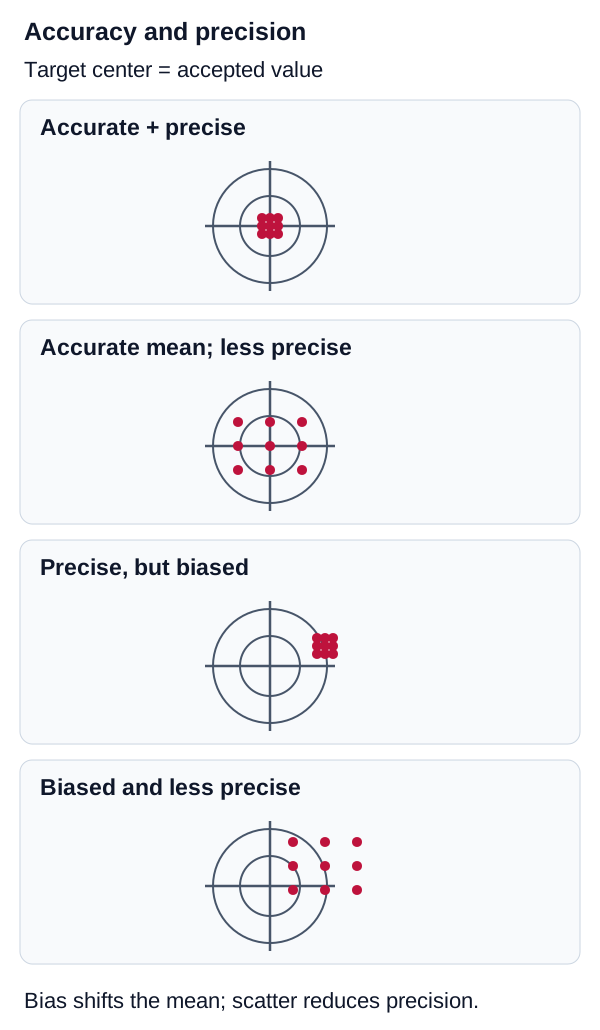
Accuracy
How close a measurement is to the true or accepted value.
Precision
How close multiple measurements of the same quantity are to each other.
Uncertainty and Significant Figures Concepts
No measurement is perfectly exact. Every measured value has an associated uncertainty, which depends on the precision of the measuring instrument and the skill of the observer. Errors in measurement can generally be classified into two types: Systematic Errors and Random Errors.
We distinguish between two critical concepts when discussing measurement quality: Accuracy and Precision.
When performing calculations with measured values, the result cannot be more precise than the least precise measurement. We use significant figures to keep track of this precision.
Rules for Significant Figures
- All non-zero digits are significant.
- Zeros between non-zero digits are significant.
- Leading zeros (to the left of the first non-zero digit) are NOT significant.
- Trailing zeros in a number with a decimal point are significant.
- When multiplying or dividing, the result must have the same number of significant figures as the measurement with the fewest significant figures.
- When adding or subtracting, the result must be rounded to the same decimal place as the measurement with the fewest decimal places.
Interactive Simulation
Adjust the measured dimensions and instrument uncertainty to see why calculated engineering quantities cannot be reported with unlimited precision.
- Non-zero digits are always significant ( has sig figs).
- Captive zeros between non-zeros are significant ( has sig figs).
- Leading zeros are never significant ( has sig fig).
- Trailing zeros are significant only if a decimal point is explicitly shown ( has sig figs; is ambiguous).
Decimal present. Leading zeros before the first non-zero digit are placeholders; captive zeros and trailing decimal zeros are significant. Total significant figures: 4. Decimal places: 2.
Decimal present. Leading zeros before the first non-zero digit are placeholders; captive zeros and trailing decimal zeros are significant. Total significant figures: 2. Decimal places: 1.
Operand A has 4 sig figs. Operand B has 2 sig figs. The least is 2 sig figs. Rounding the raw result (46.4) to 2 sig figs yields: 46.
Accuracy and precision visual
Accuracy and precision
Accuracy describes closeness to the accepted value; precision describes repeatability. Systematic bias and random scatter affect them differently.
Coordinate Systems
Cartesian Coordinate System
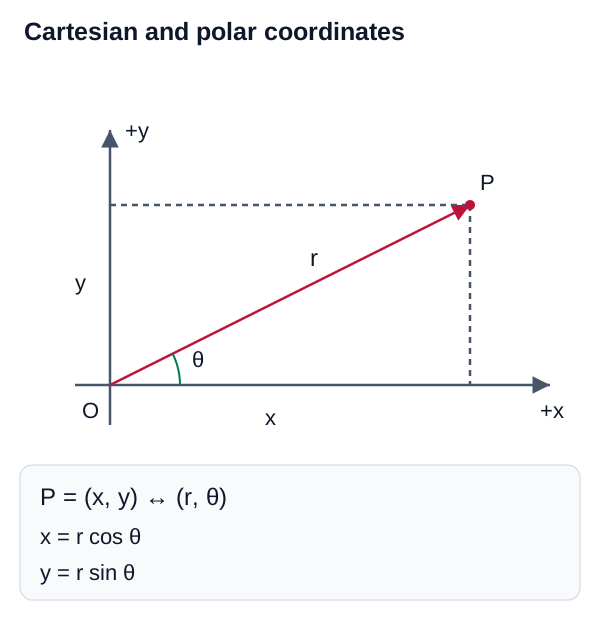
A system that specifies the location of a point or the direction of a vector using orthogonal linear axes (). It is highly intuitive for linear motion.
Polar Coordinates (2D)
A point is defined by its distance from the origin () and its angle () measured counterclockwise from the positive x-axis. Conversion: , .
Cylindrical Coordinates (3D)
An extension of polar coordinates with a -axis for height (). Commonly used for analyzing pipes, wires, and rotating cylinders.
Spherical Coordinates (3D)
A point is defined by its radial distance from the origin (), the polar angle from the positive z-axis (), and the azimuthal angle from the positive x-axis in the xy-plane (). Essential for electromagnetism and orbital mechanics.
Coordinate Systems Concepts
To specify the location of a point or the direction of a vector, we rely on coordinate systems. The most common is the Cartesian (Rectangular) Coordinate System, which is highly intuitive for linear motion.
However, in many engineering problems involving rotation, symmetry, or orbital mechanics, it is mathematically simpler to use alternative coordinate systems such as Polar Coordinates, Cylindrical Coordinates, or Spherical Coordinates.
Coordinate-system visual
Cartesian and polar coordinate descriptions
The geometry makes the conversion x = r cos theta and y = r sin theta explicit.
Scalar vs. Vector Quantities
Scalar vs. Vector Quantities Concepts
Physical quantities in engineering are broadly categorized into two types: scalars and vectors. Vectors are typically represented graphically by arrows. The length of the arrow represents the vector's magnitude (to scale), and the arrowhead points in the direction of the vector. Mathematically, vectors are often denoted by boldface letters (e.g., F, v) or with an arrow above the letter (, ).
Scalars
Scalars are quantities that are fully described by a magnitude (or numerical value) alone, along with its unit. They do not have a direction. Examples: mass, time, temperature, distance, speed, energy, density.
Vectors
Vectors are quantities that require both a magnitude and a specific direction to be fully described. They obey the rules of vector algebra. Examples: displacement, velocity, acceleration, force, momentum, electric field.
Vector Addition and Components
Vector Addition and Components Concepts
When multiple forces act on a single point (like a bridge joint), we must find their combined effect, known as the resultant vector. Vectors can be added geometrically (using the tip-to-tail triangle method or the parallelogram rule) or algebraically using the component method.
The Component Method
The Component Method Concepts
The most robust way to add vectors mathematically is to break them down into their orthogonal (, , and ) components along a Cartesian coordinate system.
A vector in 2D can be resolved into horizontal () and vertical () components. If is the angle measured counter-clockwise from the positive x-axis:
Vector X-Component
Calculates the projection of vector A onto the horizontal x-axis.
Variables
| Symbol | Description | Unit |
|---|---|---|
| Horizontal component of the vector | varies | |
| Magnitude of the vector | varies | |
| Angle relative to the positive x-axis | deg/rad |
Vector Y-Component
Calculates the projection of vector A onto the vertical y-axis.
Variables
| Symbol | Description | Unit |
|---|---|---|
| Vertical component of the vector | varies | |
| Magnitude of the vector | varies | |
| Angle relative to the positive x-axis | deg/rad |
Resultant Vector Calculation
Once you have added all the respective -components to get , and all the -components to get , you can find the magnitude and direction of the resultant vector :
Resultant Vector Magnitude
Calculates the magnitude of the resultant vector from its orthogonal components using the Pythagorean theorem.
Variables
| Symbol | Description | Unit |
|---|---|---|
| Magnitude of the resultant vector | varies | |
| Sum of all horizontal components (\sum A_x) | varies | |
| Sum of all vertical components (\sum A_y) | varies |
Resultant Vector Direction
Calculates the orientation angle of the resultant vector relative to the positive x-axis.
Variables
| Symbol | Description | Unit |
|---|---|---|
| Resultant angle | deg/rad | |
| Sum of all vertical components (\sum A_y) | varies | |
| Sum of all horizontal components (\sum A_x) | varies |
Quadrant Checking
Always check which quadrant your resultant vector is in based on the signs of and to ensure your angle is correct relative to the positive x-axis. The arctangent function typically only returns values between and .
Interactive Simulation
Use this vector addition model to connect magnitude-angle form, component form, and resultant direction in one diagram.
Unit Vectors
Unit Vectors Concepts
A unit vector is a vector that has a magnitude of exactly 1 and points in a particular direction. They are used purely to specify direction. In the Cartesian coordinate system, the unit vectors pointing in the positive , , and directions are denoted by , , and respectively.
A vector can be written in unit vector notation as:
Unit Vector Representation
Represents a three-dimensional vector as a sum of its components multiplied by their respective Cartesian unit vectors.
Variables
| Symbol | Description | Unit |
|---|---|---|
| The 3D vector | varies | |
| X-component magnitude | varies | |
| Y-component magnitude | varies | |
| Z-component magnitude | varies | |
| Unit vector along the positive x-axis | unitless | |
| Unit vector along the positive y-axis | unitless | |
| Unit vector along the positive z-axis | unitless |
Vector Multiplication
Vector Multiplication Concepts
Vectors can be multiplied together in two distinct ways, yielding either a scalar or a new vector.
1. Dot Product (Scalar Product)
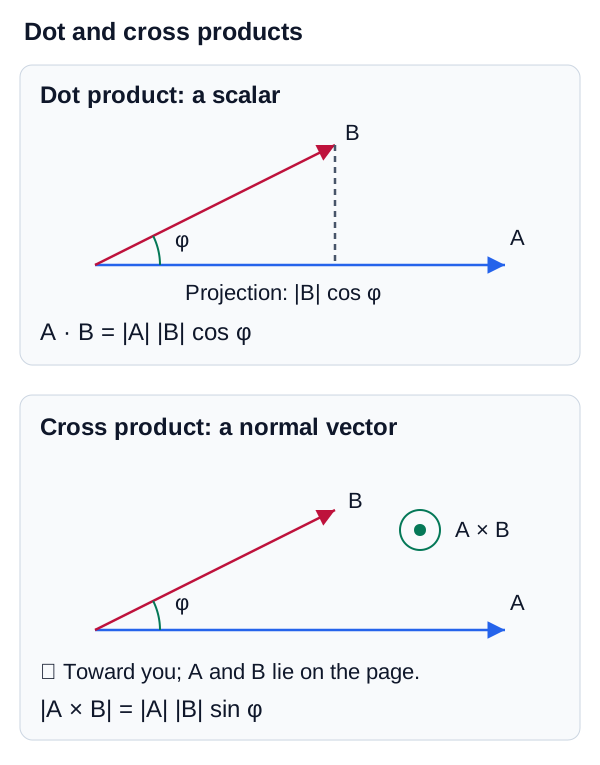
The dot product multiplies the magnitude of one vector by the component of the second vector that is parallel to the first. The result is a scalar (just a number).
Dot Product (Geometric Definition)
Calculates the scalar product of two vectors using their magnitudes and the cosine of the angle between them.
Variables
| Symbol | Description | Unit |
|---|---|---|
| Scalar dot product | varies | |
| Magnitude of vector A | varies | |
| Magnitude of vector B | varies | |
| Angle between the two vectors | deg/rad |
Dot Product Algebraic Form
In component form:
Dot Product (Algebraic Definition)
Calculates the scalar product of two vectors as the sum of the products of their corresponding Cartesian components.
Variables
| Symbol | Description | Unit |
|---|---|---|
| Scalar dot product | varies | |
| Cartesian components of vector A | varies | |
| Cartesian components of vector B | varies |
Dot Product Applications
Application: The dot product is famously used to calculate mechanical work: . It is also useful for finding the angle between two vectors, which is essential when calculating the projection of a force along a specific structural member (like a truss).
2. Cross Product (Vector Product)
The cross product results in a new vector that is strictly perpendicular to the plane formed by the two original vectors.
The magnitude of the cross product is given by:
Cross Product Magnitude
Calculates the magnitude of the vector product of two vectors, representing the area of the spanned parallelogram.
Variables
| Symbol | Description | Unit |
|---|---|---|
| Magnitude of the cross product | varies | |
| Magnitude of vector A | varies | |
| Magnitude of vector B | varies | |
| Angle between the two vectors | deg/rad |
Cross Product Direction
The direction is determined by the Right-Hand Rule. Point your right fingers in the direction of , curl them towards , and your thumb points in the direction of .
In component form using a determinant:
Cross Product (Component Form)
Calculates the resulting perpendicular vector using components.
Variables
| Symbol | Description | Unit |
|---|---|---|
| Vector cross product | varies | |
| Cartesian components of vector A | varies | |
| Cartesian components of vector B | varies | |
| Standard Cartesian unit vectors | unitless |
Cross Product Applications
Application: The cross product is essential for calculating torque (moment of a force): . In civil engineering, this is directly applicable to determining bending moments in beams and columns, and the magnetic force on a moving charge: .
Vector-product visual
Dot product and cross product
The dot product produces a scalar proportional to cosine of the included angle, while the cross product produces a perpendicular vector with magnitude proportional to sine.
Historical and Practical Significance of Standards
Standardization in Engineering
The establishment of the SI system was not merely a scientific convenience; it was a profound historical necessity. In the early days of engineering, different regions used completely different measurement systems, making global trade, scientific collaboration, and large-scale manufacturing nearly impossible.
The SI system, governed by the Bureau International des Poids et Mesures (BIPM), ensures that a kilogram in Paris is exactly the same as a kilogram in Tokyo. This standard is now based on fundamental constants of nature (like the speed of light and the Planck constant), guaranteeing its permanence. For civil engineers, adhering to these standards guarantees the safety and interoperability of construction materials and structural designs worldwide.
Error Analysis
Absolute Error
The difference between the measured value and the true (or accepted) value.
Relative (Percent) Error
The ratio of the absolute error to the true value, often expressed as a percentage.
Calculating Error
In engineering measurements, understanding the magnitude of an error is as important as the measurement itself. We quantify error using absolute and relative error calculations.
Percent Error Formula
Calculates the relative percentage error of an experimental measurement compared to the accepted theoretical value.
Variables
| Symbol | Description | Unit |
|---|---|---|
| The value obtained from measurement | varies | |
| The true or accepted standard value | varies |
- The SI System standardizes engineering measurements. Always maintain unit consistency.
- Dimensional Analysis helps verify equations and guarantees unit consistency.
- Significant Figures are crucial for representing the precision of measured data and calculations in engineering.
- Scalars have only magnitude, while Vectors have both magnitude and direction.
- Vectors are best added by breaking them into orthogonal components (, , ) and using unit vector notation (, , ).
- The Dot Product yields a scalar, useful for work and energy calculations.
- The Cross Product yields a perpendicular vector, essential for rotational dynamics and electromagnetism.
References
- Bureau International des Poids et Mesures (BIPM), The International System of Units (SI Brochure), 9th edition
- NIST, SI Units: Base and Derived Units
- OpenStax, University Physics Volume 1 — Chapter 1: Units, Measurement, Dimensional Analysis, and Significant Figures\n- OpenStax, University Physics Volume 1 — Chapter 2: Vectors