Introduction to Engineering Problem Solving and Units
Learning Objectives
- Distinguish a closed-form engineering analysis problem from the broader engineering design process.
- Apply a systematic analysis workflow using diagrams, assumptions, governing principles, calculations, and verification.
- Apply an iterative design workflow that generates and compares alternatives under criteria and constraints.
- Distinguish engineering judgment, empirical rules of thumb, code-prescribed values, test data, and analytical models.
- Use dimensional analysis and unit consistency to detect errors.
- Convert common civil engineering quantities between SI and US Customary units while distinguishing mass from force.
- Evaluate precision, significant figures, measurement uncertainty, material variability, and construction tolerance appropriately.
- Perform reasonableness checks using scale, sign, limiting behavior, independent estimates, and physical expectations.
Engineering is not the act of finding an equation that contains the unknown. It is the disciplined process of defining the real problem, representing reality with an appropriate model, obtaining and checking evidence, making decisions under constraints, and communicating a defensible result. Some tasks have one analytical answer; design tasks usually have several possible solutions that must be compared.
Engineering Analysis vs. Engineering Design
Engineering analysis
An analysis problem usually begins with a defined system and asks for a response.
Examples:
- determine the support reactions of a beam;
- compute pipe head loss for a known diameter and flow;
- estimate settlement using specified soil parameters;
- calculate excavation volume from known geometry.
The central question is: Given this model and these inputs, what response follows?
Engineering design
A design problem asks the engineer to choose or create a system that satisfies multiple requirements.
Examples:
- select a drainage alternative for a flood-prone site;
- choose a bridge type and preliminary span arrangement;
- size a pipe network while balancing pressure, constructability, and lifecycle cost;
- select a retaining system for limited right-of-way and difficult ground.
The central question is: Which feasible alternative best satisfies the required performance, safety, cost, environmental, schedule, and stakeholder constraints?
Frame the Engineering Problem
Begin with the real asset, people, constraints, evidence, and desired performance; a defensible solution starts with a well-defined question.
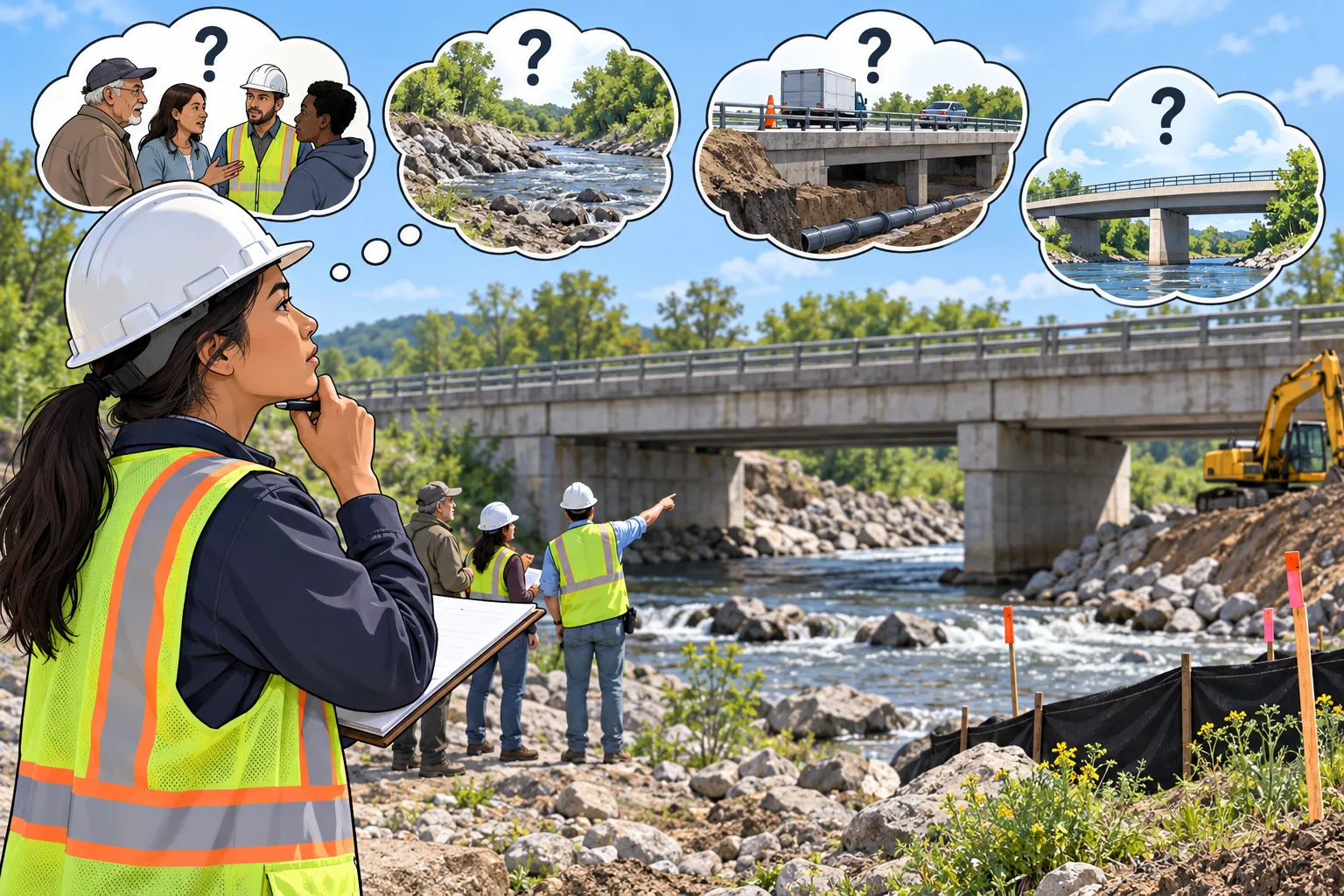
Do not confuse solving one equation with completing a design
A calculation can be mathematically correct and still be an inadequate engineering solution if the model, assumptions, constraints, loads, data, constructability, code requirements, lifecycle effects, or selected alternative are wrong.
A Systematic Engineering Analysis Method
7-Step Analysis Workflow
- Define the question. State what is known, what is unknown, the required output, and the physical system being analyzed.
- Draw and idealize. Create a sketch, free-body diagram, section, control volume, profile, or other representation. Remove irrelevant complexity but preserve the physics needed for the question.
- State assumptions and sign conventions. Identify idealizations such as steady flow, linear elasticity, negligible friction, rigid support, or simplified geometry.
- Select governing principles. Use equilibrium, compatibility, constitutive behavior, conservation of mass/energy/momentum, empirical relationships, or other justified models.
- Calculate with units visible. Carry units through the calculation and avoid premature rounding.
- Verify independently. Check dimensions, sign, scale, limiting cases, alternative calculations, or software output against hand estimates.
- Interpret and communicate. State what the result means, its precision, limitations, and whether it satisfies the actual engineering requirement.
Systematic Engineering Analysis Workflow
Move from a defined question to a justified model, visible calculation, independent verification, and an interpreted engineering result.
Receive an engineering question → Define knowns, unknowns, output, and physical system; Define knowns, unknowns, output, and physical system → Draw and idealize the system while preserving required physics; Draw and idealize the system while preserving required physics → State assumptions, sign conventions, and limitations; State assumptions, sign conventions, and limitations → Select governing principles or justified empirical models; Select governing principles or justified empirical models → Calculate with units visible and rounding controlled; Calculate with units visible and rounding controlled → Do independent checks support the result?; Do independent checks support the result? — Yes → Interpret precision, limitations, and engineering meaning; Do independent checks support the result? — No → Draw and idealize the system while preserving required physics; Interpret precision, limitations, and engineering meaning → Communicate a qualified engineering result
- Receive an engineering question: terminator
- Define knowns, unknowns, output, and physical system: process
- Draw and idealize the system while preserving required physics: process
- State assumptions, sign conventions, and limitations: process
- Select governing principles or justified empirical models: process
- Calculate with units visible and rounding controlled: process
- Do independent checks support the result?: decision
- Interpret precision, limitations, and engineering meaning: process
- Communicate a qualified engineering result: terminator
The Engineering Design Process
The repository syllabus requires the broader design process, which should be taught separately from the analytical workflow above.
Iterative Engineering Design Process
- Identify and define the need. What problem is society, the client, or the asset experiencing?
- Gather information and investigate. Obtain site data, surveys, loads, demand, hazards, standards, stakeholder needs, and existing-condition evidence.
- Establish criteria and constraints. Define safety, performance, capacity, budget, schedule, environmental, regulatory, land, material, maintenance, and constructability requirements.
- Generate alternatives. Develop more than one feasible concept before prematurely committing to a solution.
- Analyze alternatives. Model performance, risk, cost, schedule, constructability, durability, environmental effects, and uncertainty at an appropriate level of detail.
- Compare and select. Use transparent criteria to select or combine alternatives; document tradeoffs and reasons.
- Develop and implement. Produce the detailed design, drawings, specifications, procurement information, construction methods, or other deliverables required to realize the solution.
- Verify and validate. Check calculations, coordination, code compliance, constructability, testing, commissioning, and whether the delivered system actually addresses the original need.
- Communicate and document. Preserve assumptions, revisions, decisions, approvals, and limitations.
- Monitor and iterate. Learn from operation, inspection, field conditions, stakeholder feedback, or new data and revise when necessary.
Iterative Engineering Design Workflow
Treat design as a controlled loop from need and evidence through alternatives, implementation, verification, documentation, and monitored iteration.
Identify and define the need → Gather information and investigate existing conditions; Gather information and investigate existing conditions → Establish safety, performance, cost, schedule, and other constraints; Establish safety, performance, cost, schedule, and other constraints → Generate more than one feasible alternative; Generate more than one feasible alternative → Analyze performance, risk, cost, constructability, and uncertainty; Analyze performance, risk, cost, constructability, and uncertainty → Is an alternative feasible under the governing constraints?; Is an alternative feasible under the governing constraints? — Yes → Compare tradeoffs transparently and select or combine alternatives; Is an alternative feasible under the governing constraints? — No → Generate more than one feasible alternative; Compare tradeoffs transparently and select or combine alternatives → Develop and implement the selected solution; Develop and implement the selected solution → Does the delivered system satisfy the need and requirements?; Does the delivered system satisfy the need and requirements? — Yes → Communicate and document assumptions, revisions, decisions, and approvals; Does the delivered system satisfy the need and requirements? — No → Gather information and investigate existing conditions; Communicate and document assumptions, revisions, decisions, and approvals → Monitor operation, inspection, feedback, and new evidence; Monitor operation, inspection, feedback, and new evidence → Maintain the solution or begin the next iteration
- Identify and define the need: terminator
- Gather information and investigate existing conditions: process
- Establish safety, performance, cost, schedule, and other constraints: process
- Generate more than one feasible alternative: process
- Analyze performance, risk, cost, constructability, and uncertainty: process
- Is an alternative feasible under the governing constraints?: decision
- Compare tradeoffs transparently and select or combine alternatives: process
- Develop and implement the selected solution: process
- Does the delivered system satisfy the need and requirements?: decision
- Communicate and document assumptions, revisions, decisions, and approvals: document
- Monitor operation, inspection, feedback, and new evidence: process
- Maintain the solution or begin the next iteration: terminator
Iterative Engineering Design
Compare alternatives, test assumptions, document feedback, and revise the design as new evidence or constraints emerge.

Design is iterative
A credible design process often moves backward as well as forward. New geotechnical data may invalidate an early foundation concept. A cost estimate may require a different alignment. A hydraulic check may reveal that the preferred alternative cannot meet the service requirement. Iteration is evidence of disciplined engineering—not failure to "get it right the first time."
Engineering Judgment, Models, Codes, and Heuristics
Engineering Judgment
A reasoned professional decision that integrates engineering principles, evidence, experience, uncertainty, applicable requirements, and the specific context of the problem.
Heuristic
An experience-based rule of thumb or simplifying strategy used to estimate, screen, or guide a problem when a full model is unnecessary or not yet available. A heuristic is not automatically a code requirement.
Do not mix these sources of engineering information
- Analytical model: derived from physical principles and assumptions.
- Empirical relationship: fitted or inferred from observations and test data.
- Measured/test data: evidence obtained from field or laboratory procedures.
- Code-prescribed value: a requirement or design value established by the applicable code or regulation.
- Project specification: a project-specific requirement.
- Heuristic / rule of thumb: a practical approximation that may help estimate or screen a solution.
- Engineering judgment: the professional reasoning used to decide how all of these apply to the specific case.
For example, a prescribed live load from the applicable structural code should not be described merely as a "rule of thumb."
Engineering Economics and Feasibility
An engineering solution must be physically feasible, safe, lawful, constructible, maintainable, and appropriate to available resources. Economic evaluation is therefore part of design, but cost minimization is not the only objective.
Think beyond first cost
Compare alternatives using relevant measures such as:
- initial capital cost;
- operation and maintenance cost;
- rehabilitation and replacement;
- service life and durability;
- downtime and user disruption;
- energy/resource use;
- risk and consequence of failure;
- residual value or end-of-life cost.
A higher initial cost can be justified when it produces lower lifecycle cost or materially better safety, reliability, resilience, or service.
Units and Dimensional Analysis
A numerical value without a unit is incomplete engineering information. Unit consistency is one of the fastest ways to identify a calculation or data-entry error.
Dimensional Analysis
The use of physical dimensions—such as length, mass, time, and force—to verify that equations and unit conversions are physically consistent.
Units and Dimensional Reasoning
Use physical quantities and their dimensions as an early error check; a numerical result is incomplete when its units are missing or inconsistent.

Newton's Second Law
A fundamental relationship showing how SI force is derived from mass and acceleration.
Variables
| Symbol | Description | Unit |
|---|---|---|
| Force | N | |
| Mass | kg | |
| Acceleration |
Useful SI units in civil engineering
- length: mm, m, km
- area: mm², m²
- volume: m³
- mass: kg, tonne (t)
- force: N, kN, MN
- stress/pressure: Pa, kPa, MPa, GPa
- distributed load: kN/m, kN/m²
- moment: kN·m
- density: kg/m³
- unit weight: kN/m³
- flow rate: L/s, m³/s
- velocity: m/s
SI Prefixes and Engineering Notation
Common prefixes
- milli:
- kilo:
- mega:
- giga:
Examples:
Engineering notation often expresses powers of ten in multiples of three so prefixes map cleanly to units.
Mass Is Not Force
SI distinction
A kilogram (kg) is a unit of mass. A newton (N) is a unit of force.
Near Earth's surface, the weight of a mass is approximately:
with for many engineering calculations unless another value is specified.
A 100 kg mass therefore does not "weigh 100 N"; its gravitational weight is approximately 981 N under standard near-surface conditions.
US Customary caution
US Customary engineering work can use pound-force (lbf) for force and slug as a coherent mass unit. Some fields also use pound-mass (lbm), which requires careful treatment of force–mass conventions. Never convert a force as though it were a mass simply because both quantities are casually called "pounds."
Unit failure case: Mars Climate Orbiter
NASA's Mars Climate Orbiter was lost in 1999 after a navigation interface used inconsistent force-impulse units between teams. The lesson for civil engineers is not only "convert units"—it is to define interfaces, document expected units, and verify exchanged data before it enters a critical model.
Interactive Unit Converter
Interactive Simulation
Use the converter to explore units, but write the conversion factor explicitly at least once before relying on automation. The goal is to understand the dimensional relationship, not merely obtain a number.
Interactive learning lab · 3 experiences
Engineering Problem Solving and Units Learning Lab
Practice transparent unit conversion, follow the full engineering design process, and challenge calculated outputs with dimensional, magnitude, sign, and physical-reality checks.
Engineering Unit & Dimensional Reasoning Lab
Convert common civil-engineering quantities using explicit unit factors so the cancellation is visible rather than hidden inside a black-box converter.
What to observe
A unit conversion changes the numerical representation of the same physical quantity. It must preserve dimensions and should be followed by a reasonableness check.
Useful when checking material-strength or stress values expressed in different unit systems.
Unit-factor method
Reference relation: 1 psi = 0.006894757 MPa
The source unit cancels algebraically, leaving the target unit. The physical quantity and its dimension do not change merely because the unit system changes.
Common Civil Engineering Conversions
Practice quantities you will actually see
Work comfortably with conversions such as:
- MPa ↔ psi for stress or strength;
- kN ↔ lbf for force;
- kN/m³ ↔ pcf for unit weight;
- mm ↔ in for dimensions;
- m³/s ↔ L/s for flow;
- km/h ↔ m/s for traffic and dynamics;
- percent slope ↔ decimal gradient;
- hectare ↔ m² for land/watershed area.
Do not memorize dozens of constants without dimensional understanding; use an authoritative conversion and show the cancellation of units.
Verification and Sanity Checks
Before you trust the answer
- Dimensional check: Are the units physically compatible?
- Order-of-magnitude check: Is the answer roughly the expected size?
- Sign check: Does positive/negative direction match the defined convention?
- Boundary/limiting check: What happens if a parameter approaches zero or becomes very large?
- Physical-range check: Is the result possible for the material, structure, flow, or geometry?
- Independent estimate: Can a simplified method produce a comparable result?
- Graphical check: Does a plot, diagram, or deformed shape make sense?
- Software vs. hand check: Does a representative manual calculation support the model output?
- Conservation/equilibrium check: Do reactions, flows, forces, or energy balances reconcile?
Example: simple beam reasonableness
If a simply supported beam carries a symmetric vertical load:
- vertical reactions should sum to the total vertical load;
- reactions should be symmetric if geometry and loading are symmetric;
- the deflected shape should be downward under ordinary gravity loading;
- the maximum bending response should occur in a physically plausible region.
These checks can catch a wrong support, wrong unit, reversed load, or modeling error before detailed review.
Sanity-Checking an Engineering Result
Compare scale, sign, limiting behavior, and physical expectations so a plausible-looking calculation does not hide a modeling or data error.

Precision, Significant Figures, and Uncertainty
A calculator may return ten decimal places, but that does not mean the physical inputs or model are known to ten decimal places. Engineering reporting should reflect the accuracy and purpose of the information.
Sources of uncertainty and variability
- measurement resolution and instrument calibration;
- sampling and laboratory variability;
- natural variability in soil, rainfall, traffic, and materials;
- geometric construction tolerances;
- simplified analytical models;
- uncertain loads and future demand;
- numerical approximations;
- incomplete site information.
How to report precision responsibly
- Keep sufficient internal precision during calculations so rounding does not accumulate.
- Round the final reported value to a precision appropriate to the inputs, governing standard, and engineering purpose.
- Do not use a universal rule that every engineering answer must have exactly three or four significant digits.
- A survey coordinate, preliminary cost estimate, concrete strength result, structural reaction, and conceptual drainage estimate may require different reporting precision.
- Distinguish precision from accuracy: many decimal places can still be wrong.
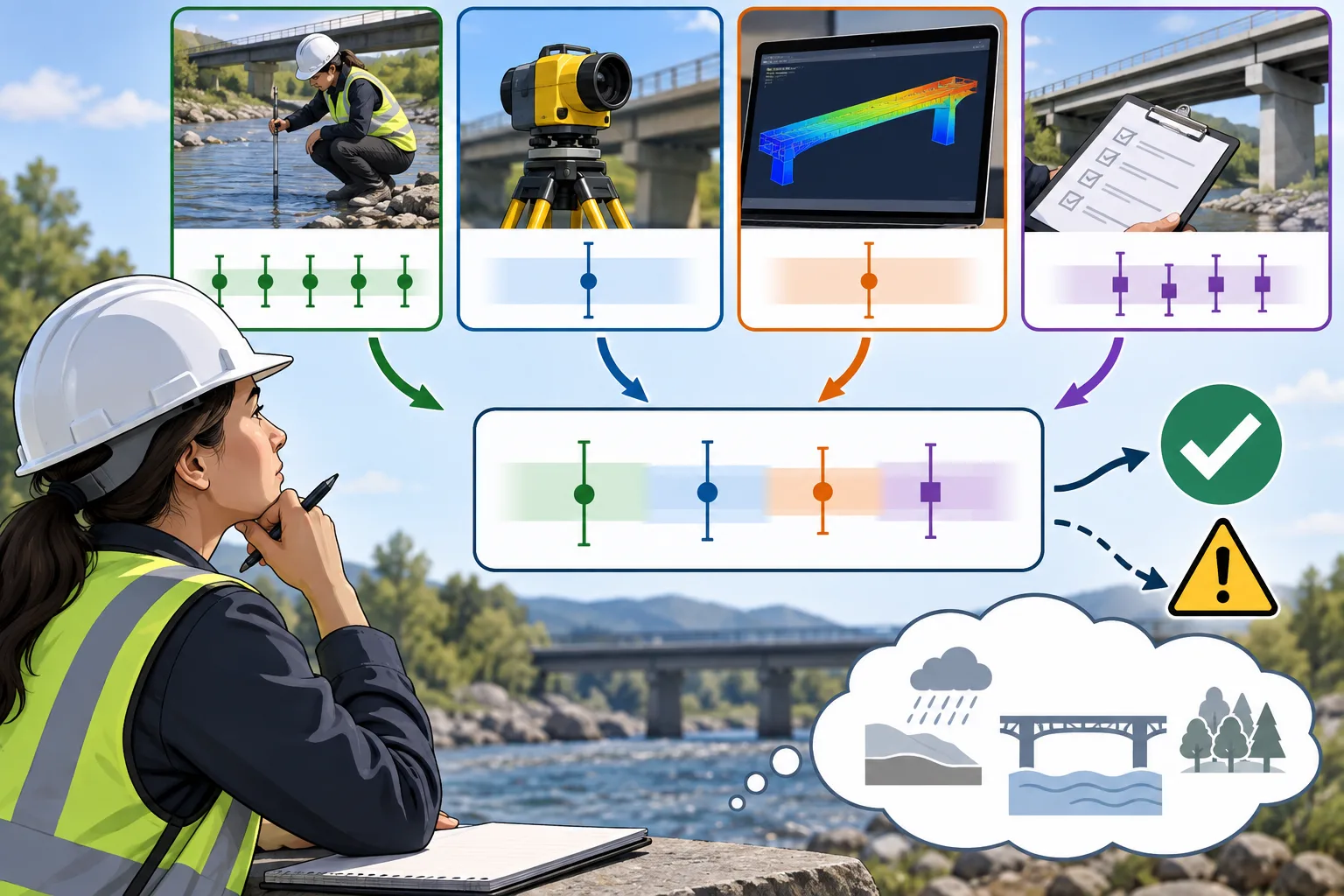
Uncertainty and Independent Verification
Treat measurements and model outputs as evidence with limits; compare independent checks before accepting a result for engineering use.
Small Civil Engineering Examples
Example 1 — excavation volume
A rectangular excavation 8 m long, 5 m wide, and 2 m deep has a geometric volume of:
Before using 80 m³ as a project quantity, ask whether side slopes, working space, over-excavation, bulking/shrinkage, groundwater, and measurement rules affect the actual paid or hauled quantity.
Example 2 — water demand screen
If a planning estimate assumes 150 L/person-day for 2,000 people:
That is a planning estimate, not a complete water-system design. Peak factors, losses, fire demand, storage, pressure, source reliability, treatment, and future growth may still govern.
Example 3 — percent grade
A road centerline rises 2.5 m over a horizontal distance of 100 m:
Always confirm whether a software tool expects the grade as 2.5% or as a decimal 0.025 before entering it.
Common Misconceptions
Check your problem-solving habits
- "Every engineering problem has one correct formula." False. Real problems often require model selection and judgment.
- "The engineering method and design process are the same thing." Not exactly. Analysis determines response for a defined model; design generates and selects among alternatives.
- "Code values are just heuristics." False. A code-prescribed value has a different authority and purpose from an informal rule of thumb.
- "If dimensions match, the answer must be correct." False. Dimensional consistency is necessary but not sufficient.
- "More decimal places mean more accuracy." False. Precision must reflect the quality of the input and model.
- "Software removes unit mistakes." False. Many programs accept internally consistent but incorrectly scaled input.
Apply It
Solve, verify, and redesign
- Choose a simple CE problem: drainage flow, beam reaction, excavation quantity, road grade, or water demand.
- Draw the system and define all units.
- State at least two assumptions.
- Solve the analytical problem.
- Perform a dimensional and order-of-magnitude check.
- Change the task into a design question by adding at least three constraints.
- Generate at least two alternatives.
- Explain what additional data you would need before making a professional design recommendation.
Content currency
Unit definitions are stable, but code-prescribed values, standard test procedures, design criteria, and software input conventions can change. This lesson emphasizes verification methods that remain valid even when the specific code or software changes. Reviewed on 15 September 2026.
- Analysis determines the response of a defined model; design generates, evaluates, and selects among alternatives under constraints.
- A strong analysis workflow includes a diagram, assumptions, governing principles, calculation, independent checks, and interpretation.
- A complete design process includes problem definition, information gathering, alternatives, evaluation, implementation, communication, verification, and iteration.
- Engineering judgment, heuristics, empirical data, code values, and analytical models are different sources of information and should not be conflated.
- Units and dimensions are essential parts of engineering data, not formatting added after the calculation.
- Mass and force must be distinguished explicitly, especially when moving between SI and US Customary systems.
- Dimensional checks, scale checks, sign checks, conservation checks, and independent estimates can expose major errors quickly.
- Significant figures should reflect input quality, purpose, standards, and uncertainty—not a universal decimal-place rule.
- A mathematically correct answer still requires physical, regulatory, constructability, and lifecycle interpretation before it becomes an engineering decision.