History of Civil Engineering

Learning Objectives

  • Trace the origins of civil engineering from prehistoric shelters to early civilizations.
  • Examine the monumental achievements of ancient engineering, including Mesopotamia, Egypt, and Rome.
  • Explore the structural innovations of the Medieval and Renaissance eras.
  • Understand the impact of the Industrial Revolution and new materials like steel and reinforced concrete.
  • Identify key historical figures who advanced the civil engineering profession.
  • Analyze the evolution of civil engineering in the Philippines, from the pre-colonial era to modern infrastructure.

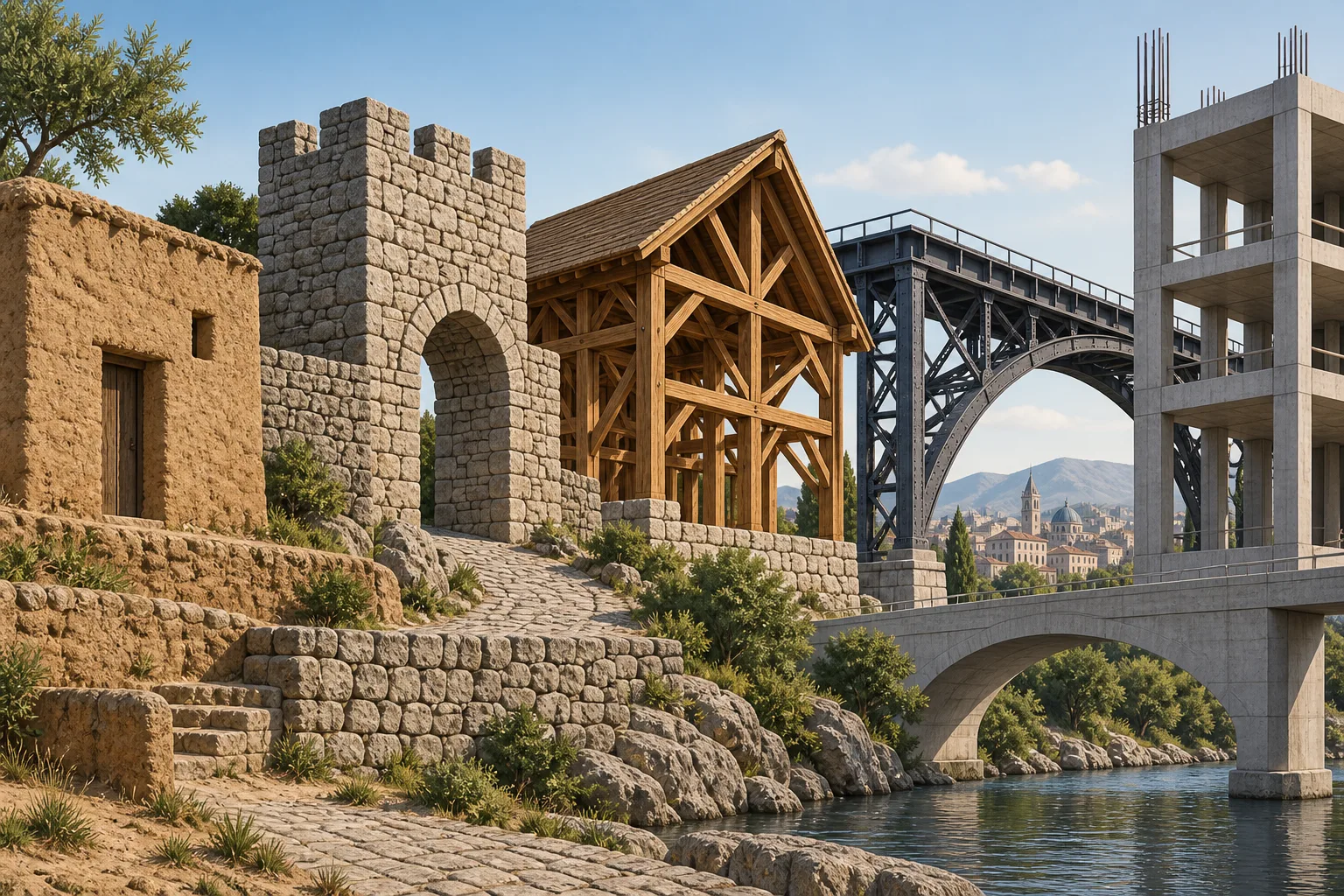
Civil engineering is arguably the oldest engineering discipline. It deals with the built environment and can be dated to the first time someone placed a roof over their head or laid a tree trunk across a river to make it easier to get across. The history of civil engineering can be divided into several eras, marking significant advancements in materials, methods, and understanding of mathematics and physics.

Civil Engineering

The professional practice of designing, constructing, and maintaining the physical and naturally built environment. This includes public works such as roads, bridges, canals, dams, airports, sewerage systems, pipelines, structural components of buildings, and railways.

Infrastructure

The basic physical and organizational structures and facilities (e.g., buildings, roads, power supplies) needed for the operation of a society or enterprise.

Interactive Timeline Simulation

Explore the interactive timeline below to see how civil engineering evolved across major historical epochs.

History of Civil Engineering

Historical Eras

Prehistoric & Ancient

4000 BC - 476 AD

The dawn of engineering with monumental structures and water management systems. Civil engineering was mostly empirical.

Key Highlights

Mesopotamia & EgyptZiggurats, Pyramids of Giza, complex irrigation systems to harness the Nile.
Indus ValleyAdvanced urban planning, grid layouts, and sophisticated drainage networks.
Ancient RomeMastery of hydraulic concrete (opus caementicium), gravity aqueducts, and extensive paved road networks spanning the empire.

Prehistoric Beginnings

Even before the great ancient civilizations, the earliest humans engaged in primitive civil engineering by creating shelters and crossing obstacles. Though unrecorded by history, these acts laid the foundation for the profession.

  • Caves and Huts: Early humans adapted natural formations and later built simple structures using timber, animal skins, and mud to protect themselves from harsh weather and predators.
  • Tree Trunk Bridges: The very first bridges were likely just fallen trees laid across streams, demonstrating a fundamental understanding of spans and structural support.

Mesopotamia and Egypt (c. 4000–2000 BC)

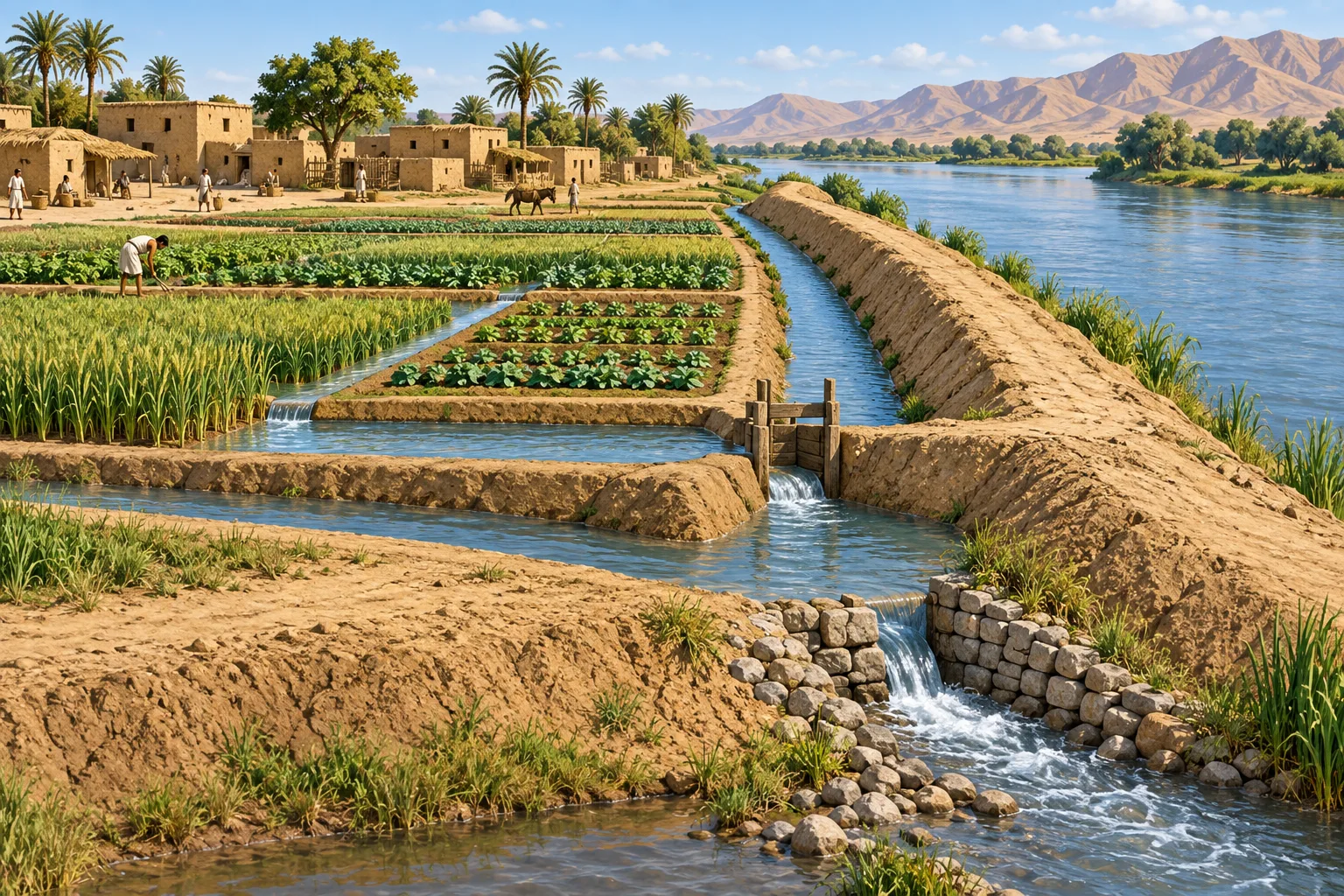
The birth of civil engineering is strictly linked to the transition from nomadic lifestyles to settled agricultural societies, creating a need for permanent shelter and irrigation.

  • The Pyramids of Giza: Massive limestone structures built as tombs for pharaohs with incredible geometric precision. The Great Pyramid of Giza was the tallest man-made structure for over 3,800 years.
  • Imhotep: The architect of the Step Pyramid of Djoser (c. 2630–2611 BC), he is widely considered one of the first named engineers in history.
  • Ziggurats: Massive structures built in ancient Mesopotamia, having the form of a terraced compound of successively receding stories or levels, acting as religious centers.
  • Irrigation Systems: Complex canal networks were developed to manage the unpredictable waters of the Nile, Tigris, and Euphrates rivers, essential for sustaining large populations through agriculture.

Indus Valley Civilization (c. 3300–1300 BC)

Known for incredibly advanced urban planning and hydraulic engineering that prioritized public sanitation.

  • Harappa and Mohenjo-Daro: These ancient cities featured strict grid-based street planning and standardized baked bricks.
  • Drainage Systems: Sophisticated underground drainage and sewage systems were present in almost every house, a feat of public health engineering not matched until the 19th century in Europe.

Ancient China (c. 2000 BC – Present)

Chinese engineering focused heavily on massive earthworks for defense and extensive water management for transportation.

  • The Great Wall of China: A series of fortifications made of stone, brick, tamped earth, wood, and other materials to protect against invasions. It remains the longest man-made structure in the world.
  • The Grand Canal: The longest canal or artificial river in the world, linking the Yellow River and the Yangtze River to transport grain to the capital.

Mesoamerican Civilizations (c. 1500 BC – 1500 AD)

The Mayans and Incas demonstrated profound mastery over harsh environments through monumental stone architecture and advanced water management without the use of metal tools or the wheel.

  • Incan Road System: A vast network of roads and rope bridges spanning the rugged Andes mountains, essential for communication and troop movement across the empire.
  • Machu Picchu: An engineering marvel of the Incas featuring dry stone walls built so precisely that a knife blade cannot fit between them, making them highly resistant to earthquakes.
  • Mayan Aqueducts: Sophisticated pressurized water systems and massive stone pyramids (like El Castillo at Chichen Itza) built with remarkable astronomical alignment.

Ancient Rome (c. 753 BC – 476 AD)

The Romans were master builders who prioritized extreme durability, utility, and standardization across their empire.

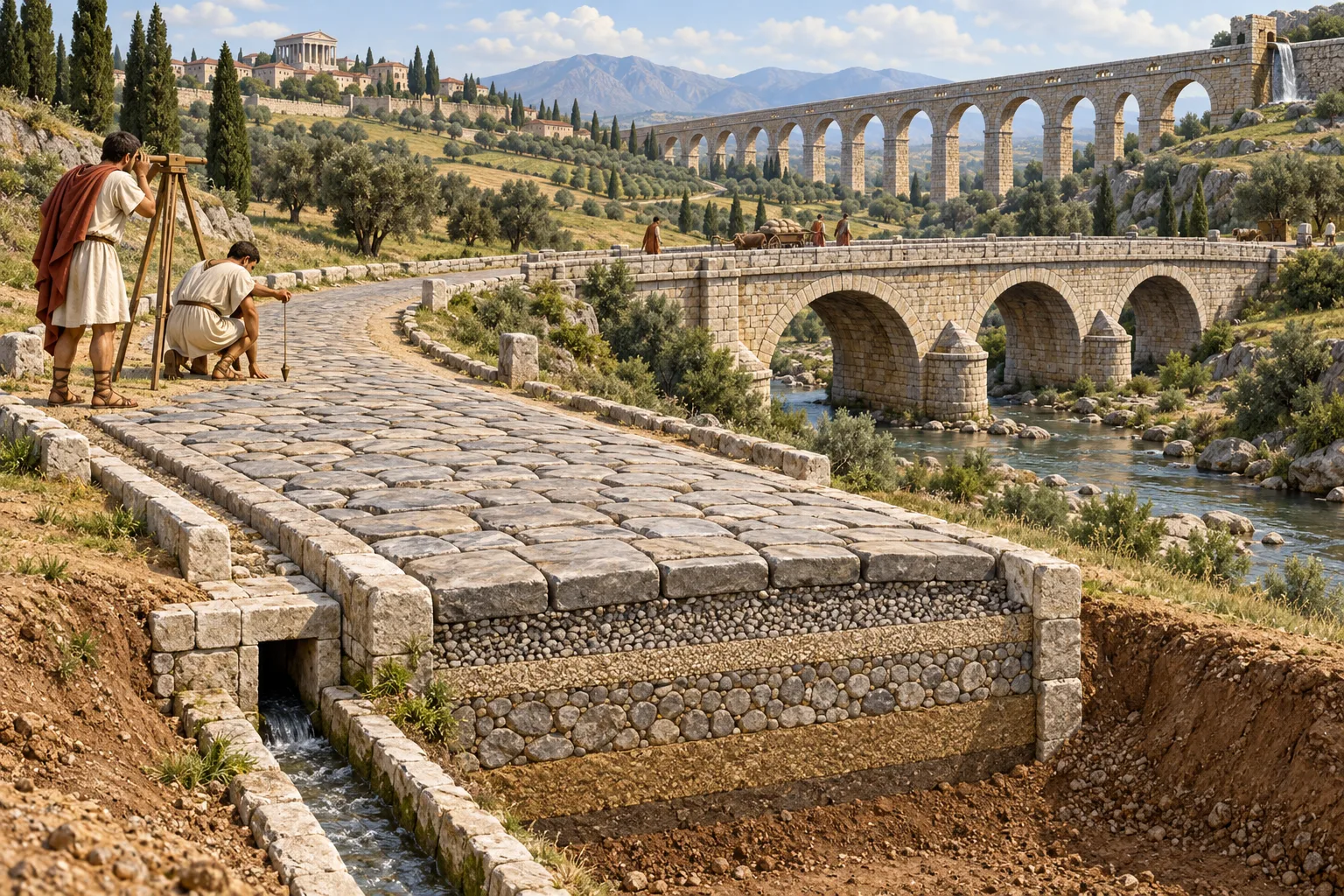
  • Roads: The Via Appia and a vast network of military roads facilitated rapid trade and troop movement. They engineered multi-layered roads with a camber (slope) for drainage, some of which are still visible today.
  • Aqueducts: Engineered to transport fresh water from distant mountain sources into cities using precise, gravity-fed slopes over dozens of miles. The Pont du Gard in France is a famous surviving example.
  • Concrete (Opus Caementicium): The Romans developed a hydraulic concrete using volcanic ash (pozzolana), which allowed them to build underwater (like harbor moles) and create massive unreinforced domes like the Pantheon, which remains the world's largest unreinforced concrete dome to this day.

Byzantine and Islamic Engineering (c. 300 – 1500 AD)

Following the fall of the Western Roman Empire, engineering knowledge was preserved and expanded in the East and the Islamic world.

  • Hagia Sophia: Built in Constantinople (modern Istanbul) in 537 AD, it featured a massive, revolutionary dome supported by pendentives, pushing the limits of Byzantine structural engineering.
  • Qanats: Deep underground aqueducts developed in Persia (and expanded by Islamic engineers) that transported water across arid regions with minimal evaporation, demonstrating advanced surveying and hydrology.

Medieval Architecture (c. 500 – 1500 AD)

During the Medieval period in Europe, engineering knowledge was preserved and expanded slowly, primarily through trial-and-error by master masons in architecture.

  • Gothic Cathedrals: A revolution in structural engineering characterized by pointed arches (which channel weight more vertically), ribbed vaults, and flying buttresses (external supports that counteract outward thrust). This allowed for immensely tall, light-filled structures previously impossible with solid masonry walls.
  • Castles and Fortifications: Defensive military engineering evolved with thicker, sloped walls to deflect projectiles, drawbridges, and complex moats.

Renaissance Thinkers (c. 1400 – 1600 AD)

The Renaissance saw a crucial revival of classical learning, observation, and the beginnings of applying scientific inquiry to construction.

  • Leonardo da Vinci: Made significant conceptual contributions to the understanding of statics, friction, and structural strength, although many of his advanced designs (like bridges and canals) were theoretical in his time.
  • Galileo Galilei: Published Dialogues Concerning Two New Sciences, effectively laying the mathematical groundwork for the analysis of structural strength and the behavior of materials under stress, moving engineering from a craft to an applied science.

The Modern Era (18th - 19th Century)

The Industrial Revolution brought about a paradigm shift, replacing timber and stone with entirely new, mass-produced materials that allowed for unprecedented scale.

  • New Materials: The mass production of Cast/Wrought Iron and later highly refined Steel revolutionized construction. Steel's immense tensile strength allowed for much longer bridge spans and taller, lighter building frames (e.g., The Eiffel Tower, Brooklyn Bridge).
  • Reinforced Concrete: Developed in the late 19th century, the combination of concrete's excellent compressive strength with embedded steel bars' tensile strength created a versatile, fire-resistant, and easily moldable composite material that dominates modern construction.
  • Formal Education: The establishment of Γ‰cole Nationale des Ponts et ChaussΓ©es (National School of Bridges and Highways) in France in 1747 marked the beginning of formal, mathematically rigorous engineering education.
  • Professional Societies: The formalization of the profession led to the establishment of the Institution of Civil Engineers (ICE) in London in 1818, and later the American Society of Civil Engineers (ASCE) in 1852, creating standardized ethical and technical codes.
  • The Profession: The Englishman John Smeaton was the first to explicitly call himself a "Civil Engineer" in the 18th century to legally and professionally distinguish his work on public infrastructure from military engineering. He is widely honored as the "Father of Civil Engineering".

The ASCE Seven Wonders of the Modern World

In 1994, the American Society of Civil Engineers (ASCE) compiled a list of the seven greatest civil engineering achievements of the 20th century to showcase the profession's impact:

  1. Channel Tunnel (UK & France): The longest undersea rail tunnel system in the world, requiring precise tunneling from two countries to meet exactly in the middle under the English Channel.
  2. CN Tower (Canada): Held the record as the world's tallest free-standing structure for 32 years, a marvel of slip-form concrete construction.
  3. Empire State Building (USA): Built during the Great Depression, it was the first building to have more than 100 floors, completed in a record 410 days.
  4. Golden Gate Bridge (USA): A monumental suspension bridge spanning the treacherous Golden Gate strait, built despite severe winds, fog, and deep water.
  5. Itaipu Dam (Brazil & Paraguay): The world's largest operating hydroelectric facility in terms of annual energy generation, a massive feat of concrete gravity dam engineering.
  6. Delta Works (Netherlands): An incredibly complex series of dams, sluices, locks, dykes, levees, and storm surge barriers protecting the low-lying Netherlands from the destructive North Sea.
  7. Panama Canal (Panama): A 50-mile waterway connecting the Atlantic and Pacific oceans, drastically reducing maritime trade routes, requiring massive earthmoving and the construction of complex water locks.

The 21st Century & Sustainable Engineering

Modern civil engineering faces new global challenges, primarily climate change, urbanization, and resource depletion.

  • Sustainable Design: Focus has shifted toward minimizing environmental impact. Programs like LEED (Leadership in Energy and Environmental Design) certify green buildings that optimize energy efficiency and material use.
  • Resilience: Designing infrastructure (bridges, seawalls, buildings) capable of withstanding extreme weather events, rising sea levels, and severe seismic activity, driven by advanced computer modeling (BIM - Building Information Modeling).

Famous Civil Engineers

  • John Smeaton (1724–1792): Father of Civil Engineering; pioneered the use of hydraulic lime in mortar and built the famous Eddystone Lighthouse.
  • Isambard Kingdom Brunel (1806–1859): A daring Victorian engineer who designed the Great Western Railway, numerous tunnels, innovative bridges, and the first propeller-driven transatlantic steamship, the SS Great Britain.
  • Gustave Eiffel (1832–1923): A French master of iron structures; best known for the Eiffel Tower and designing the complex internal iron framework that supports the Statue of Liberty.
  • Karl Terzaghi (1883–1963): Recognized globally as the "Father of Soil Mechanics"; he established the scientific principles of geotechnical engineering, allowing for safe foundation design on unpredictable soils.
  • Othmar Ammann (1879–1965): A Swiss-American engineer who designed some of the most iconic and longest suspension bridges of the 20th century, including the George Washington Bridge and Verrazzano-Narrows Bridge in New York.

Civil Engineering in the Philippines

The history of the profession in the Philippines closely reflects its pre-colonial ingenuity, colonial past, and modern rapid development.

  • Pre-Colonial Period:
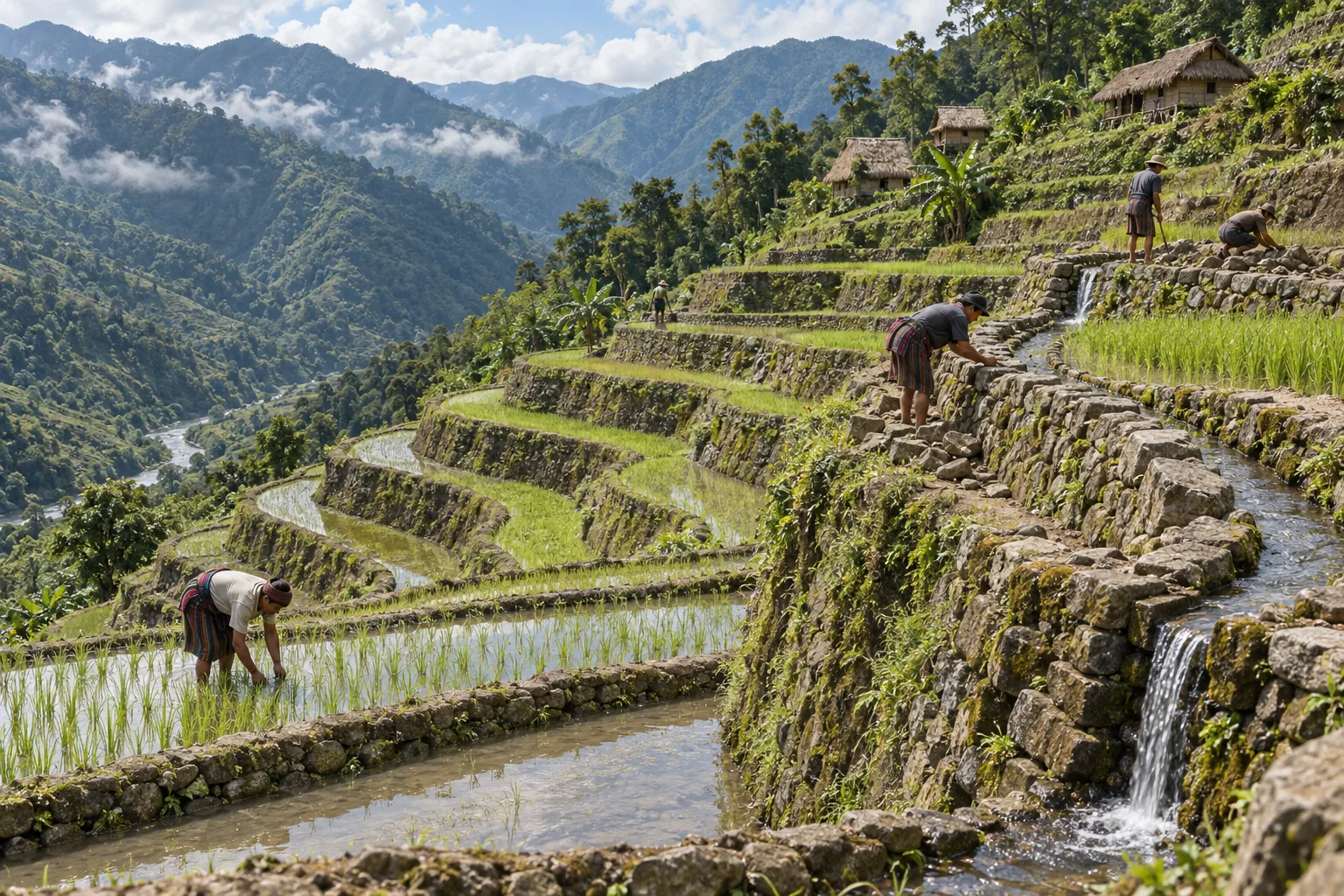
    • Rice Terraces of the Cordilleras: Built by the Ifugaos over 2,000 years ago using carefully placed stone and mud walls. They are a UNESCO World Heritage site demonstrating absolute mastery of watershed management, hydrology, and terrace engineering on incredibly steep mountain slopes.
  • Spanish Era:
    • Intramuros: The walled fortress city of Manila, featuring massive stone walls, deep moats, defensive bastions, and heavily fortified gates based on European military engineering principles.
    • Churches and Bridges: The construction of massive, earthquake-resistant baroque churches (e.g., San Agustin Church) and durable stone arches and bridges (Puente de EspaΓ±a) utilizing local materials like adobe, brick, and coral stones bonded with lime mortar.
  • American Era and Post-WWII Reconstruction:
    • Public Works: The American administration formally introduced modern reinforced concrete and structural steel, establishing the Bureau of Public Works (the predecessor of today's DPWH).
    • Kennon Road: A major and highly dangerous engineering feat carved through mountain ranges connecting the lowlands to the summer capital of Baguio City.
    • Post-WWII: Manila was one of the most heavily devastated cities in World War II. The post-war era saw massive reconstruction efforts, rapidly rebuilding bridges, government buildings, and establishing major national highways to connect the archipelago.
  • Modern Infrastructure: Today's landscape is characterized by deep-foundation high-rise buildings in Makati and BGC, extensive elevated expressways (Skyway, NLEX, SLEX), and complex mass transit railway systems (LRT/MRT/Subway).
Key Takeaways
  • Civil engineering originated from humanity's basic survival needs for shelter, safe passage, and agriculture (irrigation).
  • The Ancient Civilizations (Mesopotamia, Egypt, Indus Valley, China, Mesoamerica, Rome) pioneered urban planning, monumental architecture, and extensive water management systems.
  • The Romans significantly advanced the field through the invention of Opus Caementicium (hydraulic concrete), extensive road networks, and gravity-fed aqueducts.
  • The Medieval Period in Europe introduced significant structural innovations, particularly the Gothic Cathedral (pointed arches, ribbed vaults, flying buttresses).
  • The Industrial Revolution marked a pivotal shift with the mass production of new materials like Cast Iron, Steel, and eventually Reinforced Concrete, enabling unprecedented structural scale.
  • John Smeaton legally formalized the profession by coining the term "Civil Engineer".
  • The ASCE's Seven Wonders of the Modern World highlight the immense scale, difficulty, and global impact of 20th-century civil engineering achievements.
  • The 21st century emphasizes sustainable engineering (LEED) and resilient infrastructure.
  • Philippine civil engineering history spans from the ancient Ifugao Rice Terraces to heavy stone masonry during the Spanish Era, massive Post-WWII reconstruction, and into the modern concrete and steel infrastructure of today.