Strain Energy
Learning Objectives
- Relate external work to elastic strain energy in linear structural members.
- Compute strain energy for axial, bending, and torsional deformation.
- Distinguish strain-energy density, modulus of resilience, and modulus of toughness.
- Use energy balance to explain sudden and impact loading.
- Apply Castigliano's second theorem conceptually to obtain structural displacement.
Strain Energy
Strain energy is the internal energy stored in a deformable body as external loads perform work through elastic deformation.
A Spring as an Elastic Energy Store
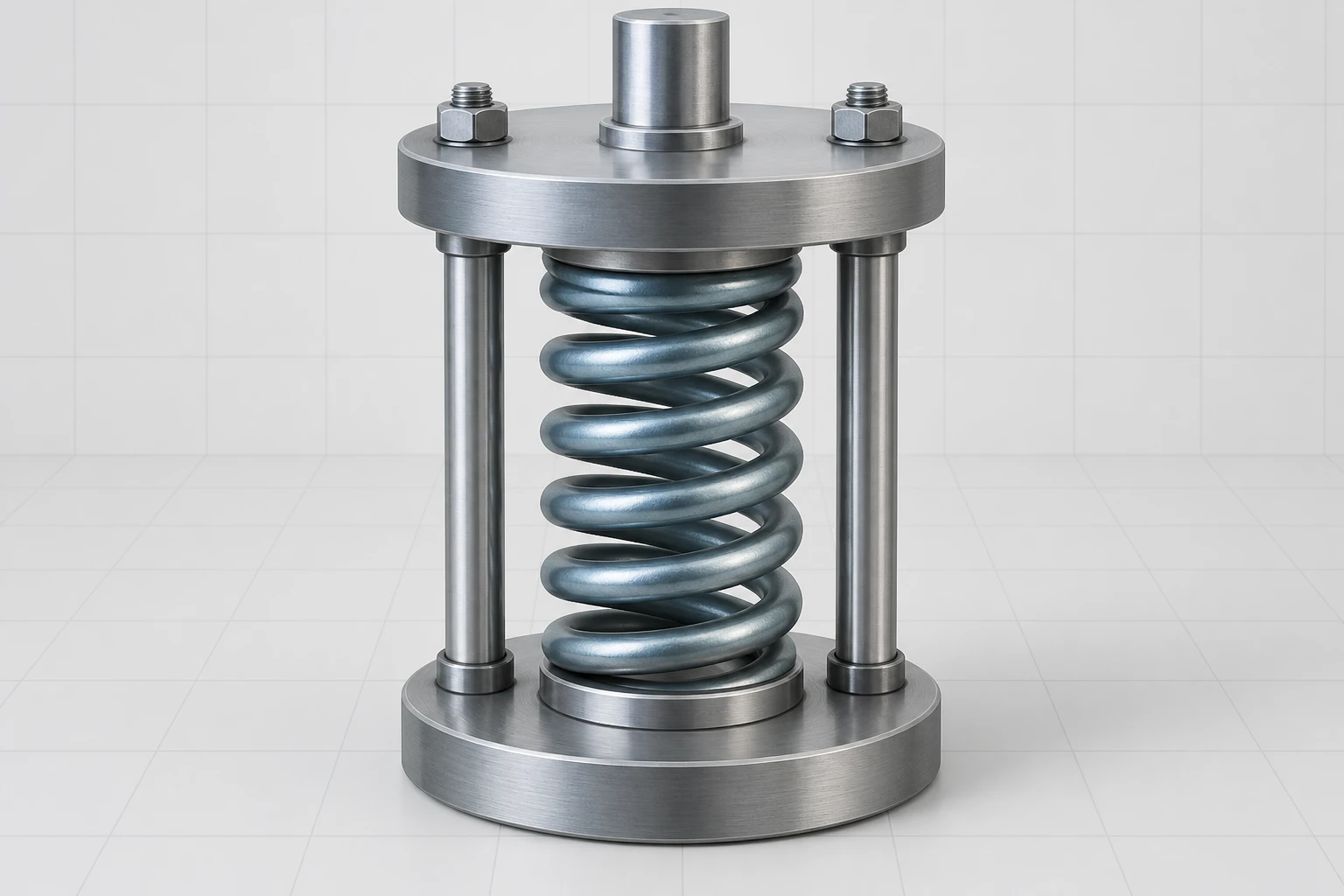
The intact coil and connected end plates provide physical context for reversible elastic storage; use the formulas and simulation for exact work, deformation, and energy relationships.
Reading the Spring Context
The spring is a qualitative elastic member: its intact coil and seated ends suggest recoverable storage and release, but the raster does not establish a force, extension, stiffness, or stored-energy value. Use the load-deformation relation and interactive model for exact calculations and assumptions.
Linear-Elastic Load-Deformation Energy
Area under a linear load-deformation curve for a gradually applied load.
Axial Strain Energy
Elastic strain energy in a prismatic bar under constant axial force.
Bending Strain Energy
Elastic strain energy stored by bending along a beam or frame member.
Bending Energy in a Member
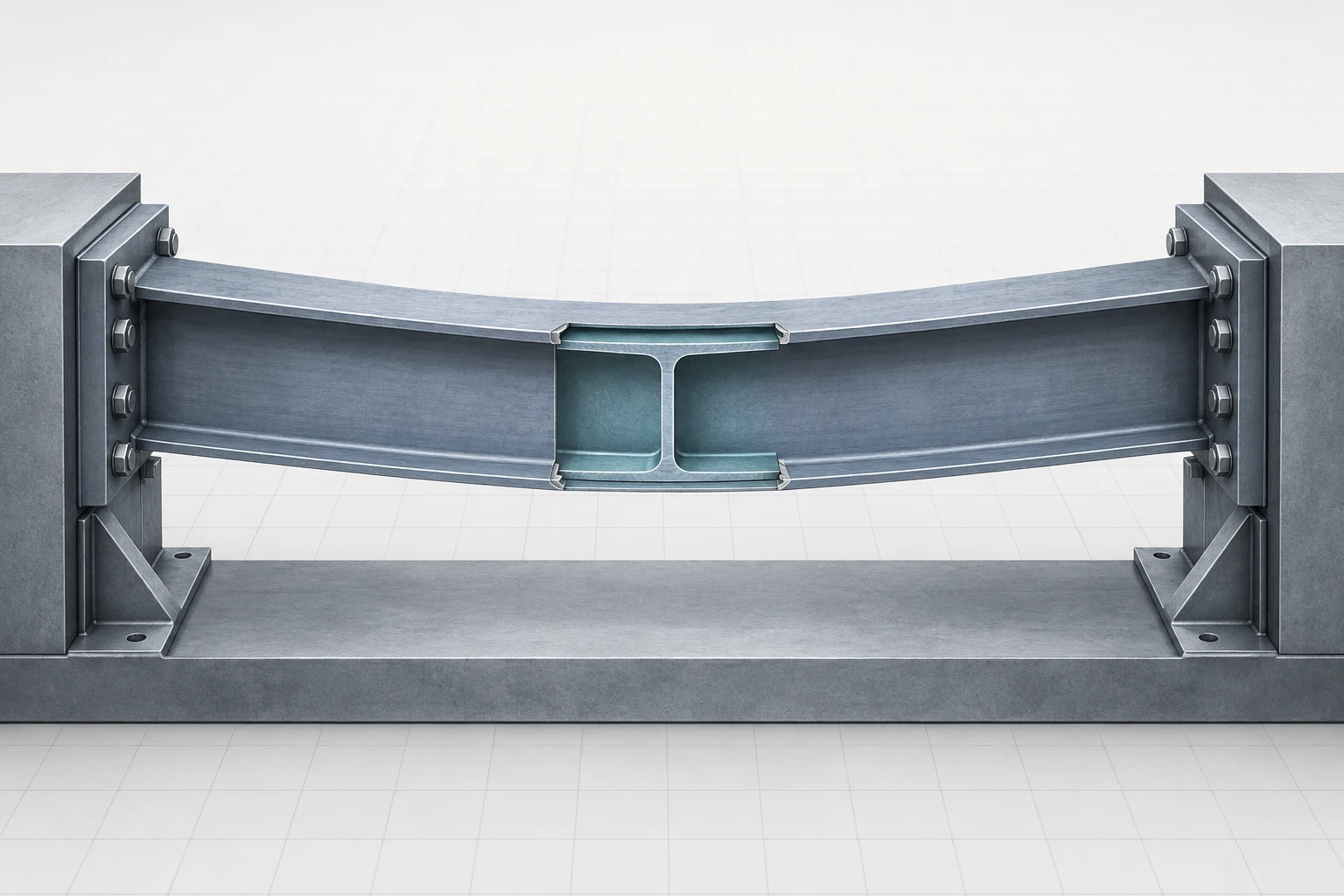
The connected flanges and web keep the member volume visible through a qualitative flexural state; use the bending integral for the exact energy distribution and stored work.
Reading the Flexural Context
The mild bow and midspan section reveal show where a connected member can deform elastically in bending. They are contextual only, not a deflection curve, stress map, load case, or numerical result; use the deterministic formula and worked examples for quantitative interpretation.
Torsional Strain Energy
Elastic strain energy in a prismatic circular shaft under torque.
Torsional Energy in a Shaft
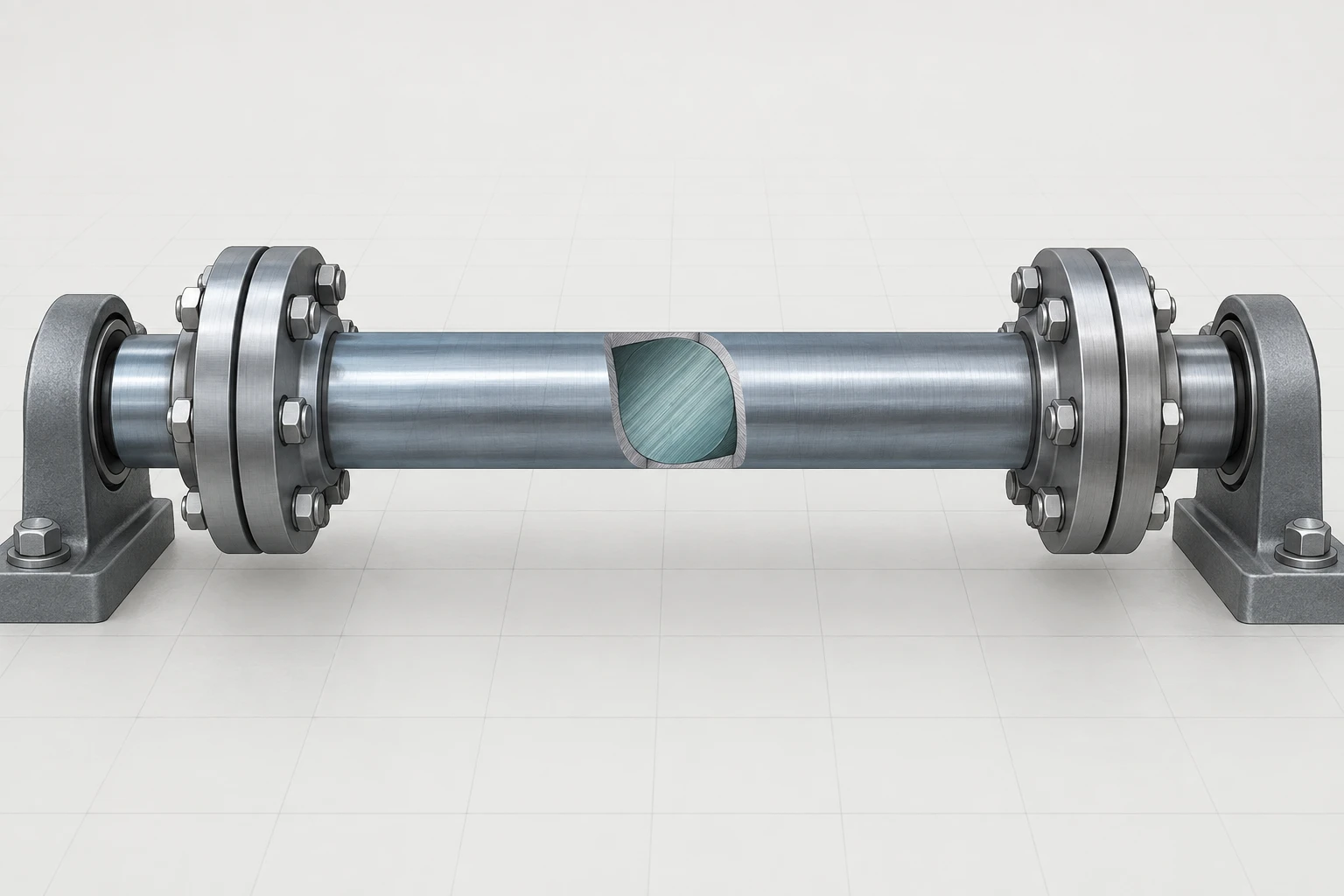
The continuous shaft and couplings show the member volume that participates in elastic torsion; use the torsional formula for exact energy calculations.
Reading the Shaft Context
The shaft is shown at rest so the circular member and its connected couplings remain legible. The section reveal is qualitative and does not specify a twist angle, torque, power, stress, or stored-energy value; use the torsional relation for the engineering calculation.
Energy as Area Under a Response Curve
For a conservative elastic system, strain energy equals the area under the load-deformation curve. The factor in is specific to a load that rises linearly from zero to . It should not be applied blindly to nonlinear response.
Elastic Energy in a Member
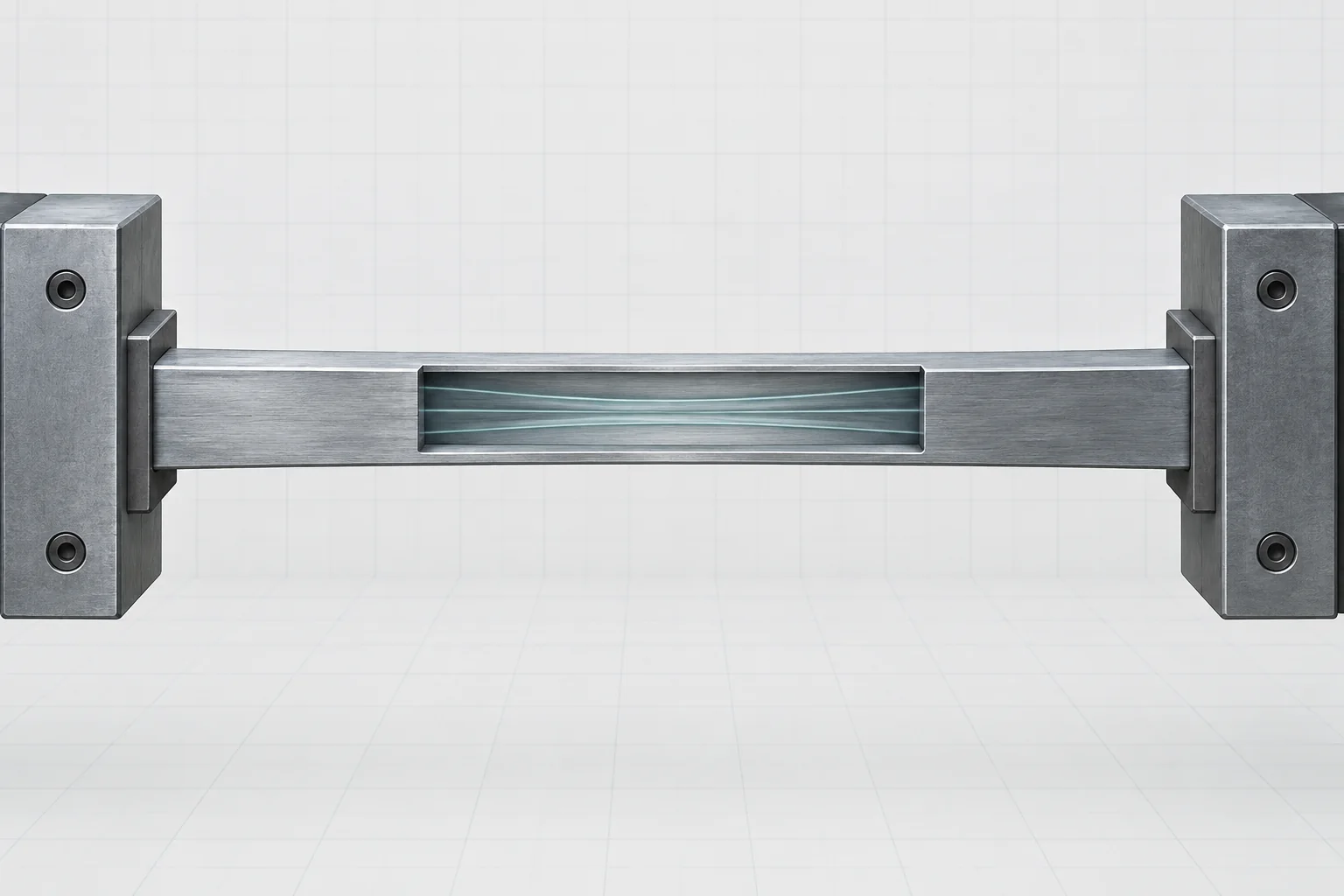
The continuous bar and plain section reveal provide physical context for elastic energy stored through deformation; use the nearby equations and simulation for exact load, deformation, and energy relationships.
Reading the Elastic-Member Context
The bar is shown as a qualitative elastic member: its material volume remains continuous while the central region undergoes a small reversible deformation. The cutaway is not a measurement or a stress/energy distribution; use the deterministic load-deformation graph and formulas for the quantitative area and stored-energy calculations.
Strain-Energy Density
Strain-energy density is stored elastic energy per unit material volume.
Uniaxial Elastic Strain-Energy Density
Energy per unit volume under linear uniaxial normal stress.
Modulus of Resilience
The modulus of resilience is the strain energy per unit volume that can be stored up to the elastic or yield limit used by the model.
Modulus of Resilience
Linear-elastic resilience based on yield stress.
Modulus of Toughness
The modulus of toughness is the total energy per unit volume represented by the area under the stress-strain curve up to fracture.
Resilience versus Toughness
Resilience concerns recoverable energy before permanent deformation; toughness includes elastic and plastic energy absorbed up to fracture. Toughness therefore cannot generally be computed from a single linear-elastic modulus and yield stress.
Interactive Exploration
Vary axial load, length, area, and modulus. Observe the corresponding deformation, load-deformation energy triangle, and stored elastic strain energy.
Controls
P/A
σ/E
PL/(AE)
P²L/(2AE)
σ²/(2E)
Sudden and Impact Loading
Dynamic loading is evaluated by energy and dynamics, not by simply substituting a larger static force without justification. For an ideal linear spring-like member, a load applied suddenly from zero height produces a peak response twice the gradually applied static response. A falling weight adds gravitational potential energy over both the drop height and the subsequent structural displacement.
An Elastic Buffer at an Impact Interface
The stationary striker, compliant pad, and rigid fixture provide physical context for impact-energy absorption; use the energy balance and stated assumptions for idealized response.
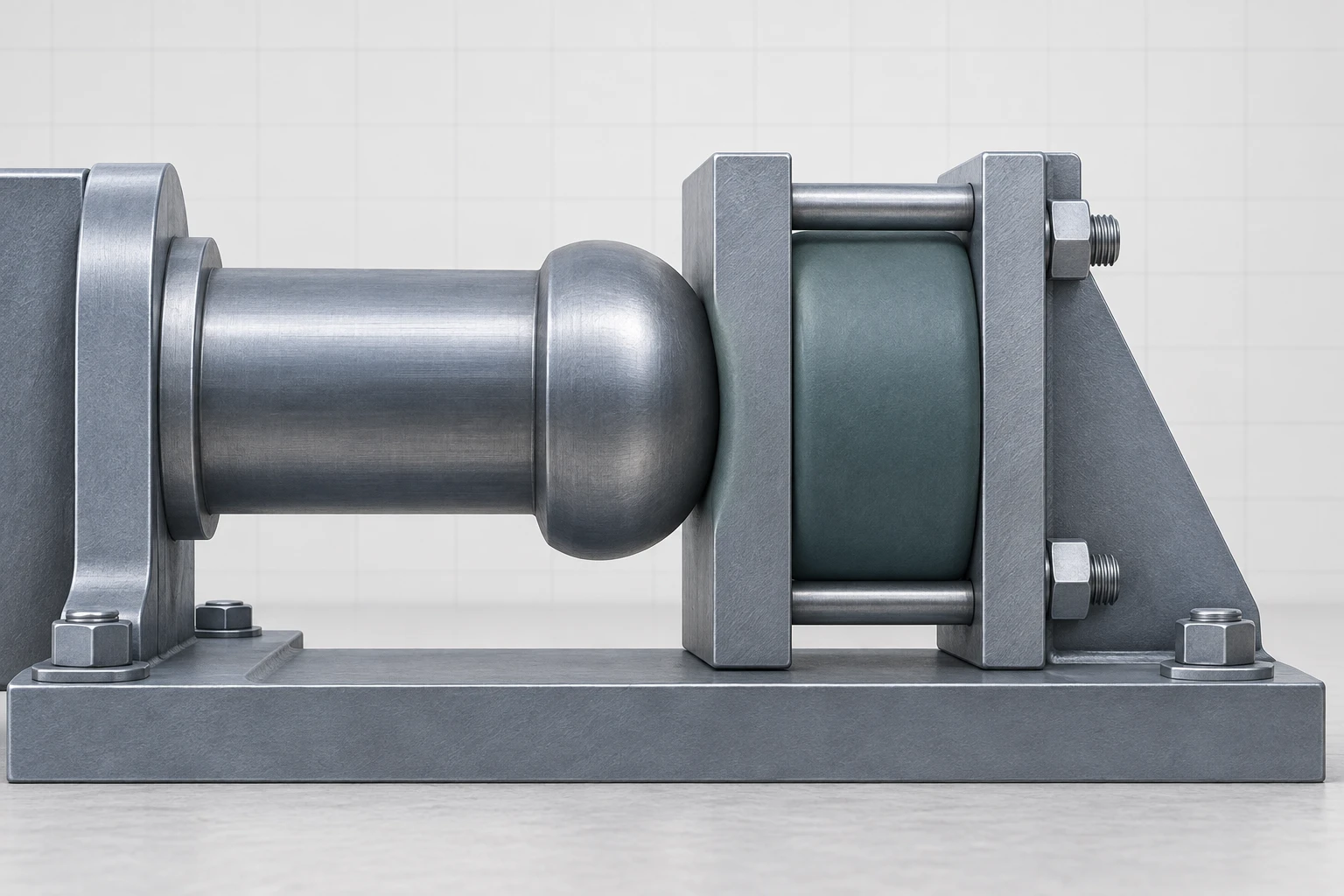
Reading the Impact-Buffer Context
The fixture is a static qualitative interface: the pad is shown between a striker and a rigid frame, but the raster does not establish motion, contact force, damping, stroke, or a performance rating. Use the idealized energy balance only with its stated assumptions and limits.
Ideal Falling-Weight Energy Balance
Simplified energy balance for a weight falling onto a linear-elastic member.
Impact Model Assumptions
The simple energy balance neglects effects such as local contact deformation, damping, wave propagation, plasticity, and energy lost to sound or damage. State the idealizations before applying a closed-form impact factor to real structural systems.
Castigliano's Second Theorem
For a linearly elastic structure with strain energy expressed in terms of applied loads, the partial derivative of total strain energy with respect to a load gives the displacement in that load's direction.
Castigliano's Second Theorem
Displacement from the derivative of total strain energy.
Dummy-Load Technique
If the desired displacement direction has no real applied load, introduce a symbolic dummy load at the point and direction of interest, express the internal-force functions including that load, differentiate the total strain energy with respect to it, and then set the dummy load to zero.
Energy-Method Workflow
Energy methods are especially useful when direct geometric integration is cumbersome but internal-force expressions are manageable.
Choose displacement point and direction → Is there an actual load in that direction?; Is there an actual load in that direction? — Yes → Express N, M, T, or other relevant internal actions; Is there an actual load in that direction? — No → Introduce symbolic dummy load Q; Introduce symbolic dummy load Q → Express N, M, T, or other relevant internal actions; Express N, M, T, or other relevant internal actions → Form total elastic strain energy U; Form total elastic strain energy U → Differentiate U with respect to the target load; Differentiate U with respect to the target load → Set Q = 0 if a dummy load was introduced; Set Q = 0 if a dummy load was introduced → Check units, sign, symmetry, and boundary behavior; Check units, sign, symmetry, and boundary behavior → Report displacement and assumptions
- Choose displacement point and direction: terminator
- Is there an actual load in that direction?: decision
- Introduce symbolic dummy load Q: process
- Express N, M, T, or other relevant internal actions: process
- Form total elastic strain energy U: process
- Differentiate U with respect to the target load: process
- Set Q = 0 if a dummy load was introduced: process
- Check units, sign, symmetry, and boundary behavior: process
- Report displacement and assumptions: terminator
Maxwell-Betti Reciprocity
For linear elastic structures satisfying the reciprocity assumptions, the displacement at point caused by a unit load at point equals the displacement at caused by the same unit load applied at in the corresponding direction. Reciprocity is a useful analytical check and underpins many structural-analysis formulations.
- Strain energy is the work stored through elastic deformation.
- Axial, bending, and torsional deformation each have corresponding energy expressions.
- Resilience measures recoverable energy capacity; toughness includes energy absorption through fracture.
- Sudden and impact loading require an energy/dynamic model and explicit assumptions.
- Castigliano's theorem converts derivatives of strain energy into displacements for linear elastic structures.