Introduction to Mechanics
Learning Objectives
- Define mechanics, rigid-body statics, and the modeling assumptions used in architectural analysis.
- Distinguish scalar quantities from vectors and describe a force by magnitude, direction, line of action, and point of application.
- Explain particle, rigid-body, and concentrated-load idealizations and select an appropriate model for a structural situation.
- Relate Newton's laws to equilibrium, weight, and action-reaction pairs.
- Resolve a force into Cartesian components and check equations for dimensional consistency.
- Use SI units consistently and recognize when a static idealization is no longer appropriate.
Mechanics
Statics
Rigid Body
Why Statics Matters in Architecture
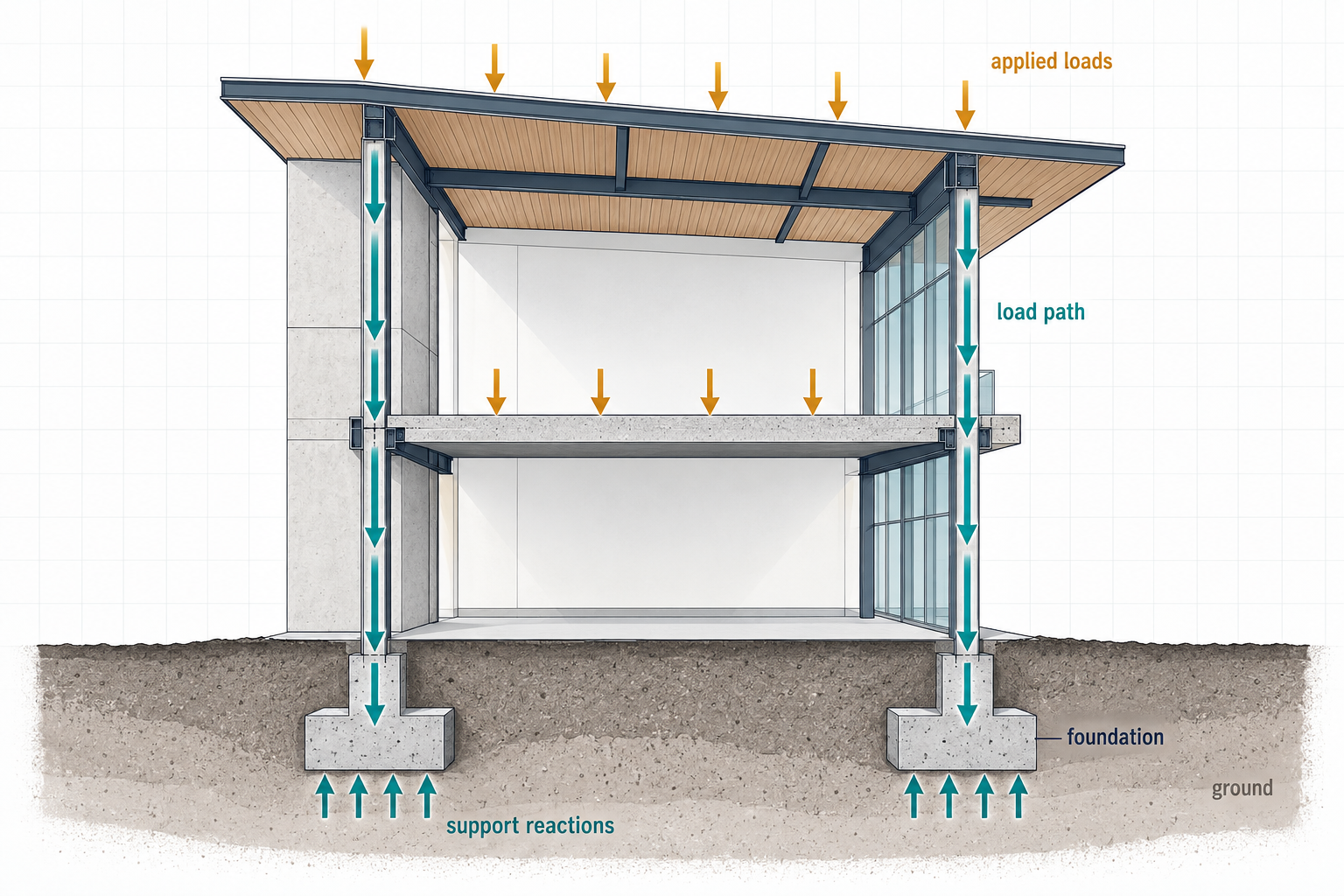
Architectural form creates load paths. Roofs, floors, façades, stairs, canopies, trusses, frames, walls, and foundations must transfer actions safely to the ground. Statics provides the first-level tools for tracing those actions and determining the reactions and internal force demands that later design courses use.
A correct statics model separates geometry, loads, supports, and assumptions. Attractive geometry alone does not establish structural equilibrium.
Architectural Load Path
Follow the downward load-path arrows from the applied roof and floor loads through the columns and walls to the foundations and ground. The visual emphasizes how statics separates geometry, loads, supports, and reactions when tracing an architectural load path.
Basic Quantities and SI Units
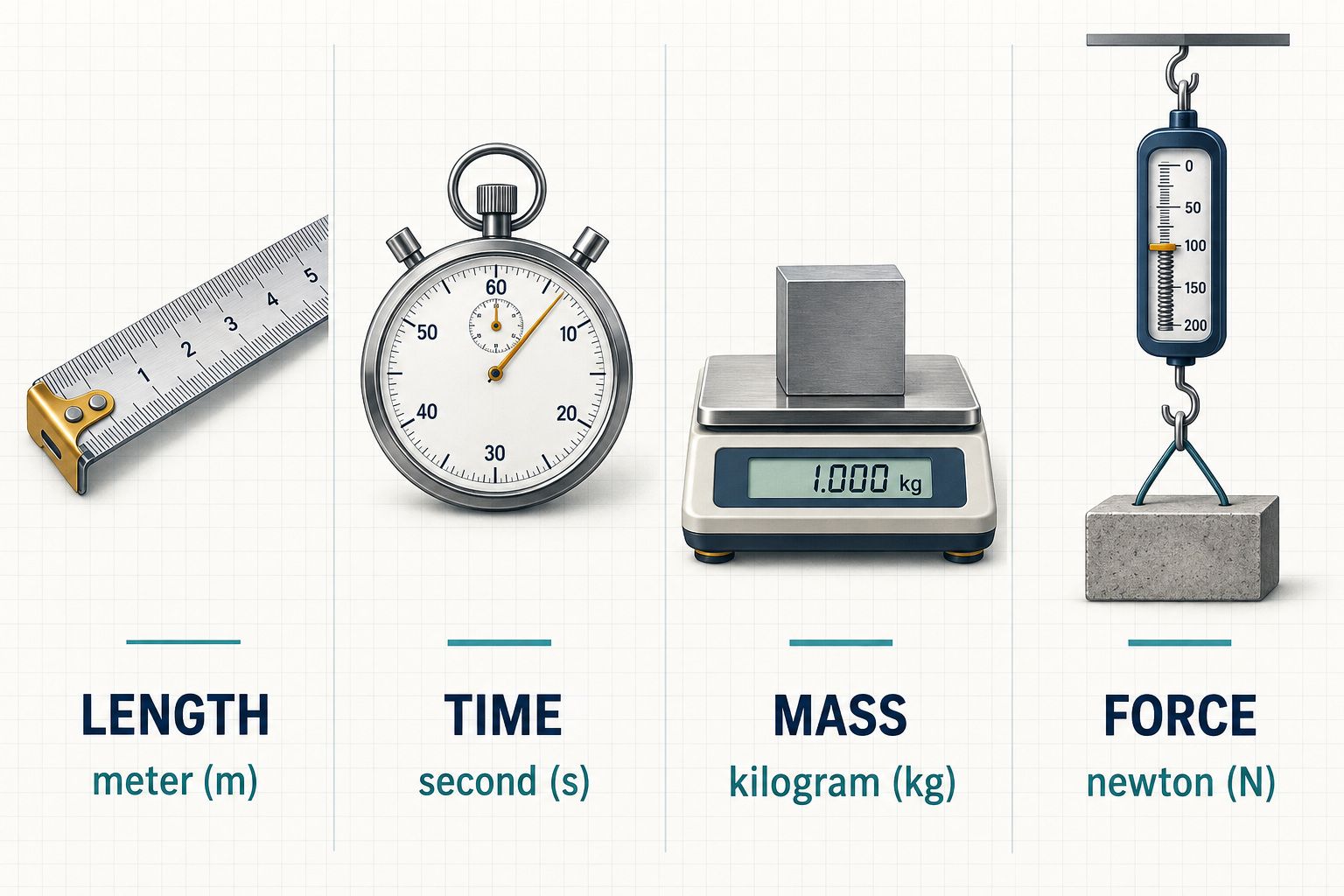
Four quantities recur throughout classical mechanics:
- Length locates points and defines geometry.
- Time is not explicitly present in a strictly static solution, but becomes essential in dynamics.
- Mass measures inertia and is a scalar quantity.
- Force is a vector action that can change motion or maintain equilibrium through interaction with other forces.
Basic Mechanics Quantities
Use the four stations to connect each recurring mechanics quantity to its SI unit: length to meters, time to seconds, mass to kilograms, and force to newtons. The force gauge shows a physical push or pull without introducing vector decomposition.
Structural Idealizations
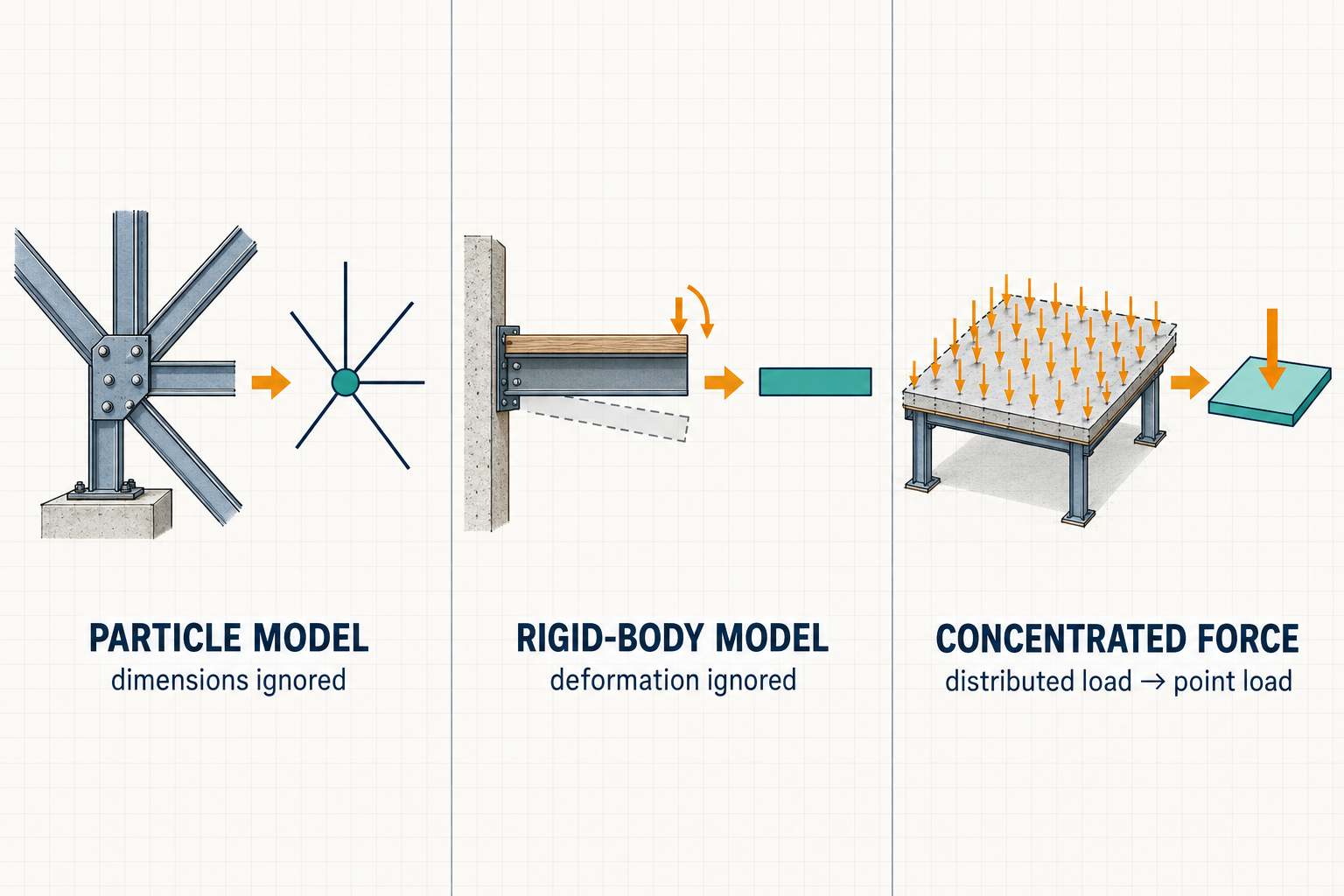
Common idealizations include:
- a particle, used when body dimensions are irrelevant to the force balance;
- a rigid body, used when dimensions and moments matter but deformation can be neglected; and
- a concentrated force, used when a load acting over a small region can be represented by an equivalent point load for the model being studied.
Structural Idealizations
Read each panel from left to right: a real joint becomes a particle when dimensions do not affect force balance, a member becomes a rigid body when deformation can be neglected, and a distributed floor load becomes an equivalent point load. These are modeling choices, not claims that real structures have no size or deformation.
Force
Scalars and Vectors
A scalar has magnitude only. Examples include mass, temperature, area, and volume. A vector has magnitude and direction. Structural force, displacement, velocity, and acceleration are vectors.
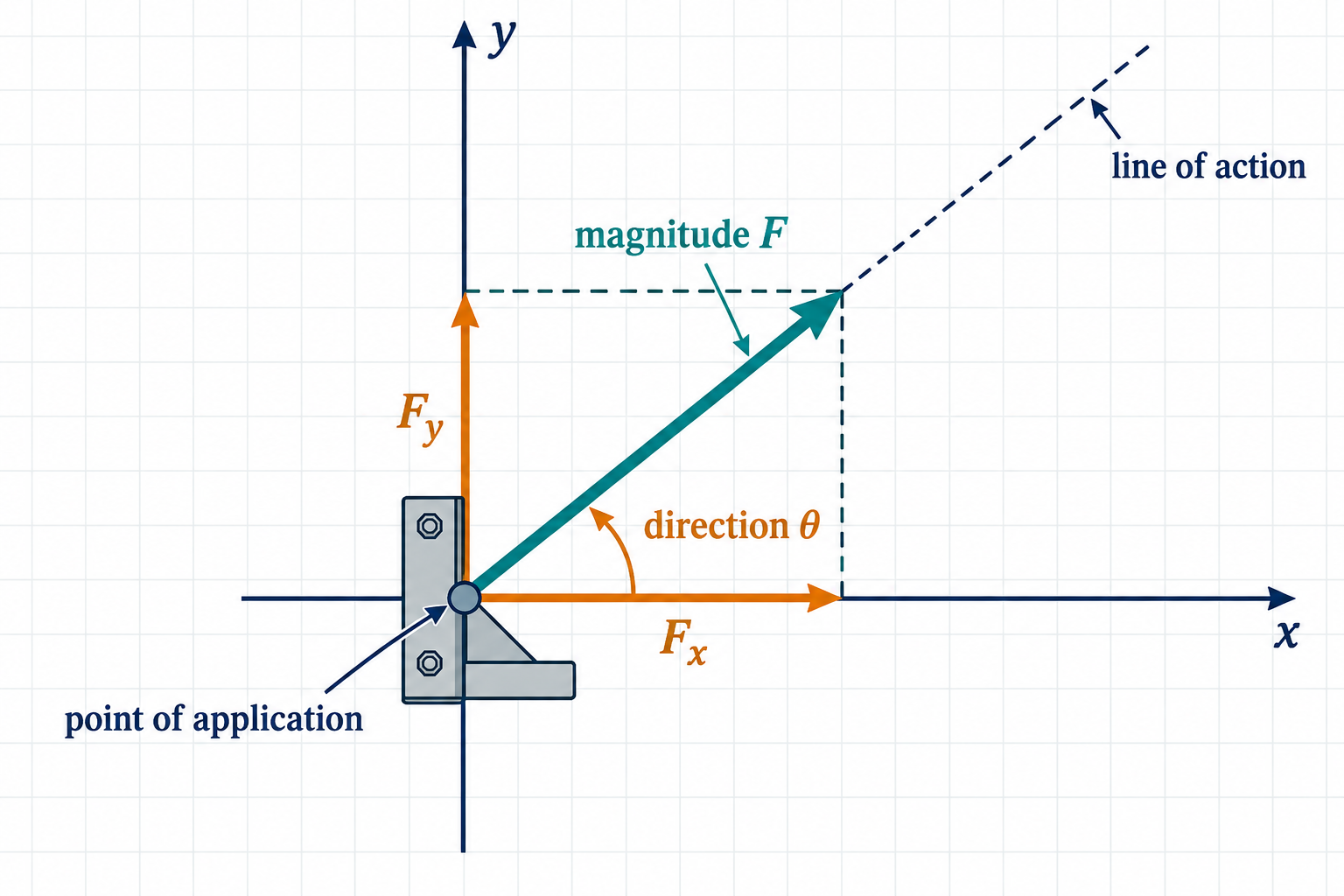
For a planar force acting at angle measured counterclockwise from the positive -axis, the Cartesian components are and .
Planar Force Components
Resolves a force into mutually perpendicular Cartesian components.
Variables
| Symbol | Description | Unit |
|---|---|---|
| Force magnitude | N | |
| Horizontal force component | N | |
| Vertical force component | N | |
| Angle measured from the positive x-axis | deg |
Anatomy of a Planar Force
Observe the point of application, diagonal line of action, magnitude, direction, and perpendicular horizontal and vertical components. The component arrows reconstruct the original planar force, supporting the decomposition formula without replacing the calculation.
Vector Addition and Resultants
Two or more forces acting on the same body can be replaced, for the purpose of external equilibrium, by their vector resultant when the replacement preserves the force-system effect. Graphically, two concurrent vectors can be added with the triangle or parallelogram construction. Analytically, component summation is usually more reliable.
Concurrent Resultant
Combines signed Cartesian force components and recovers the planar resultant magnitude.
Variables
| Symbol | Description | Unit |
|---|---|---|
| Horizontal resultant component | N | |
| Vertical resultant component | N | |
| Resultant force magnitude | N |
Principle of Transmissibility
For a rigid body, moving a force anywhere along its same line of action does not change the force's external effect on the body. Moving it to a parallel but different line of action is not equivalent unless an accompanying couple is introduced.
This distinction is crucial when simplifying architectural load paths: a force may be slid along its line of action, but it cannot be arbitrarily relocated across the structure.
Newton's Laws and Static Equilibrium
Newton's laws provide the physical foundation for statics:
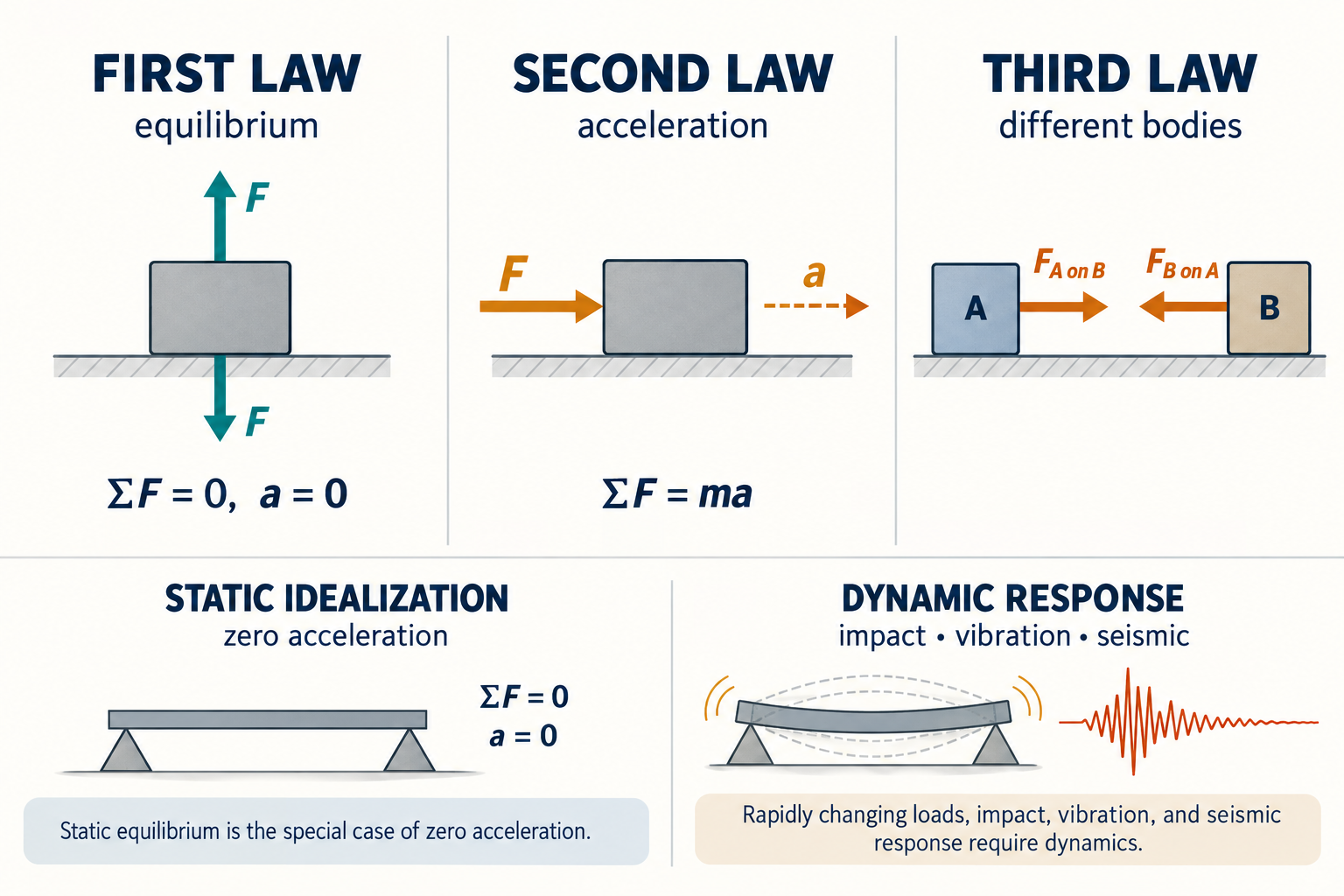
- First law: if the resultant force is zero, a particle has no acceleration.
- Second law: the resultant force equals mass times acceleration. Static equilibrium is the special case .
- Third law: interaction forces between two bodies occur as equal-magnitude, opposite-direction pairs acting on different bodies.
The third-law pair must not be placed on the same free-body diagram unless both interacting bodies are included in that single system boundary.
Newton's Laws and Model Limits
Read across the upper panels to connect equilibrium, acceleration, and equal-and-opposite interaction forces acting on different bodies. The lower comparison shows why zero-acceleration static idealization is not sufficient for impact, vibration, or seismic response.
Weight Near Earth's Surface
Relates mass to the gravitational force commonly used as a dead load idealization.
Variables
| Symbol | Description | Unit |
|---|---|---|
| Weight | N | |
| Mass | kg | |
| Local gravitational acceleration, approximately 9.81 m/s² for ordinary engineering calculations near Earth's surface |
Interactive Exploration
Use the simulation to compare force, mass, and acceleration and to see how Newton's laws connect dynamic behavior with the zero-acceleration condition used in statics.
Planar and Spatial Models
A planar model is appropriate when all relevant geometry and force lines lie in one plane or when a three-dimensional system can be isolated into a valid two-dimensional slice. A spatial model is required when the , , and directions and three-dimensional moments materially affect equilibrium.
The decision is a modeling judgment. A two-dimensional sketch is not automatically a valid planar model of a three-dimensional building.
Units and Dimensional Homogeneity
Use a consistent unit system throughout a calculation. In SI mechanics, one newton is one kilogram-metre per second squared.
Structural work commonly uses , , and . Convert quantities before substitution rather than mixing incompatible units inside an equation.
Dimensional homogeneity is a powerful error check: every term added or equated must have compatible physical dimensions.
Mass Is Not Weight
Mass is measured in kilograms and is not a force. Weight is measured in newtons and depends on gravitational acceleration. Treating kilograms as newtons introduces a factor-of- error.
Limits of the Static Idealization
Static analysis assumes zero acceleration and usually treats bodies as rigid. Rapidly varying wind, impact, machinery vibration, seismic response, resonance, and cases where deformation significantly changes equilibrium require dynamic or second-order models beyond elementary statics.
The purpose of statics is not to claim that real buildings are perfectly rigid; it is to construct an appropriately simplified equilibrium model for the question being asked.
- Statics is the zero-acceleration branch of mechanics and is the foundation of structural equilibrium analysis.
- A force is a vector defined by magnitude, direction and sense, line of action, and point of application.
- Particle, rigid-body, and concentrated-load idealizations simplify real architectural systems while preserving the behavior relevant to the model.
- Newton's second law reduces to equilibrium when acceleration is zero, while third-law pairs act on different interacting bodies.
- Vector components and consistent SI units make force calculations systematic and auditable.
- A force may be transmitted along its own line of action on a rigid body, but relocating it to another line requires moment equivalence.
- Static assumptions must be abandoned when inertia, significant deformation, or time-dependent response governs.